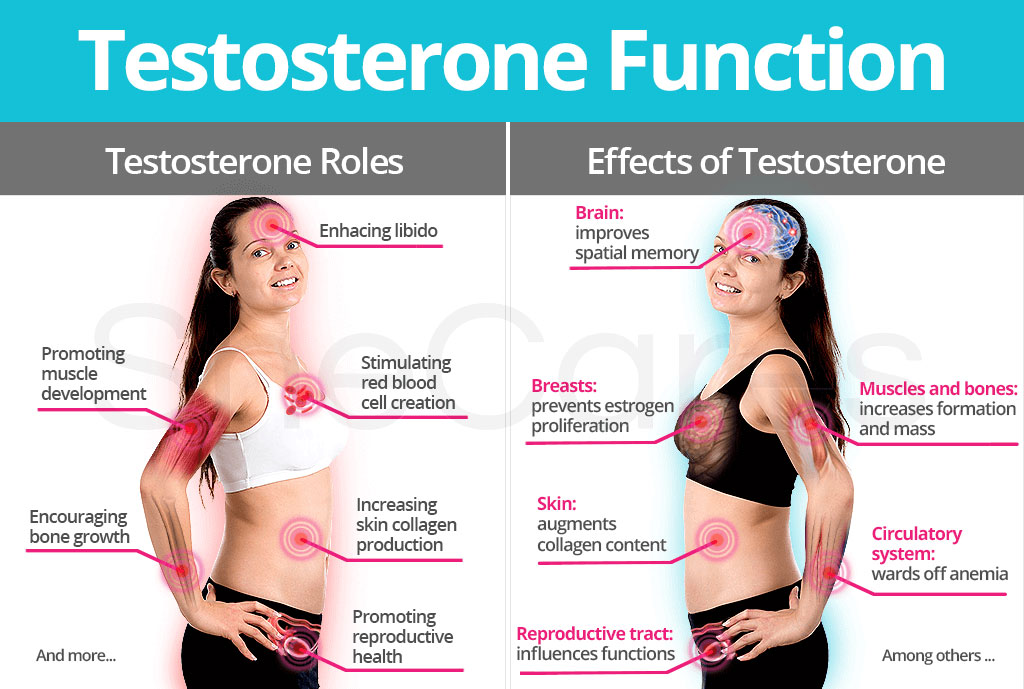
Similar to estrogen and progesterone, testosterone has a plethora of non-reproductive effects throughout the female body, thanks to numerous receptors and glands that facilitate its functions. Accordingly, a testosterone imbalance is likely to evoke many side effects. To discover more little known roles and effects of testosterone, continue reading.
Testosterone Roles
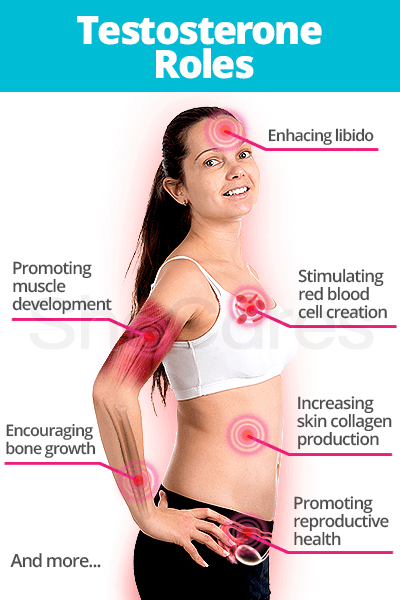
Testosterone in women is instrumental for physical and psychological well-being, contributing to a healthy circulatory system, brain, and more.
Contrary to popular belief, testosterone is not simply in charge of sustaining a woman's libido and sexual function. Androgen receptors are located on almost all tissuesin the woman's body, including those of the heart, blood vessels, brain, lungs, spinal cord, reproductive and endocrine glands, bones, muscles, and more.
The range of tasks that testosterone carries out in the female body include:
- Encouraging bone growth and density
- Stimulating the production of red blood cells
- Promoting muscle development
- Improving mood and sex drive
- Upholding greater skin collagen content
- Promoting health of reproductive tract
- And other crucial functions.
To learn more about testosterone's continual contribution to varying body parts, including effects from high and low testosterone levels, continue reading.
Effects of Testosterone in the Female Body
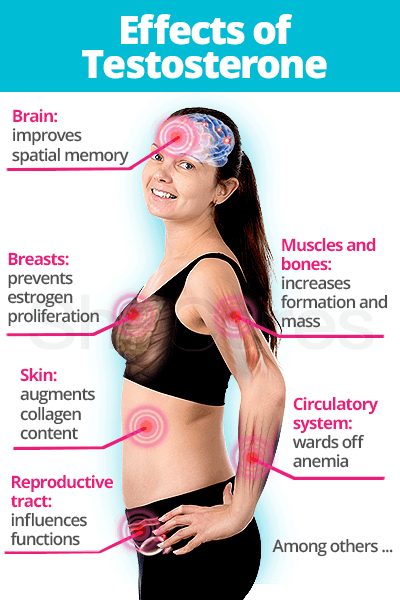
Effects of healthy testosterone levels in women are felt throughout their bodies:
Reproductive tract. Androgens, such as testosterone, influence female reproductive functions, including the ovaries, uterus, vagina, and clitoris. In early follicular development, receptors are located on various ovarian cells. As such, dysregulation of testosterone may upset normal reproductive development.
Circulatory system. Testosterone plays an important part in red blood cell (RBC) formation, also known as erythropoiesis, and helps protect women against anemia, a condition characterized by insufficient supplies of RBCs or oxygen-carrying hemoglobin.
Muscles and bones. Testosterone is believed to increase bone mass and periosteal bone formation. Results of two studies employing testosterone implants in addition to HRT showed noteworthy positive effects on bone mineral density. The hormone also helps increase muscular growth and maintains muscle mass.
Breasts. For women suffering from a testosterone deficiency, research suggests that treatment with testosterone (hormone therapy) could prevent proliferation of estrogen cells in the breast, thus decreasing breast cancer risk.
Skin. Healthy testosterone levels in women contribute to greater skin collagen content and thickness. This is especially evident in menopausal women, whose skin collagen content has been found to decline due to lower testosterone and estrogen levels.
Brain. Research suggests that testosterone helps prevent Alzheimer's disease because it modifies brain structures, particularly the hippocampus, which is responsible for the formation of one's memory. Studies show that women with sufficient testosterone levels have improved spatial memory.
Possible Effects of High Testosterone Levels
Reproductive tract. High levels of testosterone can cause an enlargement of the clitoris as well as amenorrhea, an absence of menstrual periods.
Circulatory system. High levels of testosterone can increase cholesterol levels and the risk of liver and heart disease.
Muscles and bones. Aside from androgens exerting positive effects on bone mass in women, high testosterone levels also contribute to an extreme increase of muscle mass.
Skin. A couple of the first telltale signs of high androgen levels – specifically testosterone – are greasy skin and acne due to increased sebum production. These are also common indicators of polycystic ovarian syndrome (PCOS).
Hair. Another prominent sign of high testosterone levels is hirsutism, which is male-patterned hair growth on a woman's face, chest, and back. High levels can also contribute to a male-patterned baldness known as androgenic alopecia.
Brain. It has been shown that higher testosterone levels that are still within normal ranges are associated with better mental rotation in women. The effects of excessively high testosterone levels on the female brain is yet to be discovered.
Possible Effects of Low Testosterone Levels
Reproductive tract. Testosterone deficiency may lead to lower libido and decreased vaginal lubrication, even in women who are menstruating regularly. Genital arousal and orgasmic response may also be negatively affected.
Circulatory system. Lower levels of testosterone may increase the risk of anemia. Also, research suggests that women with low testosterone levels develop heart disease sooner.
Muscles and bones. In some studies, it has been found that androgen levels, such as testosterone, are low in women with hip or vertebral fractures. However, results were conflicting.
Hair. It has been found that even with lower levels of testosterone, dehydrotestosterone (DHT)-triggered hair loss can occur in women. DHT is a derivative of testosterone that is responsible for female patterned baldness. It shrinks hair follicles, making it impossible for them to grow
Brain. Research also suggests that women with low testosterone lose their memory more quickly than those with normal levels. Also, low levels of testosterone may inhibit the ability to concentrate and lead to diminished interest in daily activities, lower libido, sleep disturbances, depressed moods, and irritability.
All in all, due to testosterone's aforementioned and other roles and effects in the female body, maintaining healthy levels is of the utmost importance. Not only is the hormone vital for sexual health, but it also helps with correct functioning of the cardiovascular, musculoskeletal, and integumentary systems, among others.
When fluctuations of testosterone levels occur, this imbalance can elicit bothersome symptoms. Nevertheless, there are times within a woman's reproductive life that garner such fluctuations due to varying circumstances. Read more about testosterone levels for a better understanding of the normal range of testosterone levels.Sources
- Celec, P. et al. (2015). On the effects of testosterone on brain behavioral functions. Frontiers in Neuroscience, 9, 12. doi: 10.3389/fnins.2015.00012
- Chang, C. et al. (2013). Androgen Receptor (AR) Physiological Roles in Male and Female Reproductive Systems: Lessons Learned from AR-Knockout Mice Lacking AR in Selective Cells. Biology of Reproduction, 89(1), 21. doi: 10.1095/biolreprod.113.109132
- Drutz, H. P. et al. (Eds.). (2003). Female Pelvic Medicine and Reconstructive Pelvic Surgery. London: Springer-Verlag. Available from Google Books.
- Kryger, A.H. (2004). Listen To Your Hormones: A doctor's Guide to Sex, Love, and Long Life. California: WellnessMD Publications. Available from Google Books.
- McMaster Pathophysiology Review. (n.d.). Sex Hormone Synthesis, Regulation, and Function. Retrieved June 22, 2018, from http://www.pathophys.org/sexhormones/
- Mohamed, N. et al. (2016). A concise review of testosterone and bone health. Clinical Interventions in Aging, 11, 1317-1324. doi: 10.2147/CIA.S115472
- Rosen, C.J. et al. (Eds.). (1999). The Aging Skeleton. California: Academic Press. Available from Google Books.
- Shufelt, C.L. & Braunstein, G.D. (2008). Testosterone and the breast. Menopause International, 14(3), 117-122. doi: 10.1258/mi.2008.008015.
- Society for Endocrinology. (2018). Testosterone. Retrieved June 22, 2018, from http://www.yourhormones.info/hormones/testosterone.aspx
- Traish, A.M. et al. (2002). Role of androgens in female genital sexual arousal: receptor expression, structure, and function. Fertility and Sterility, Suppl 4, S11-S18. Retrieved June 22, 2018, from https://www.ncbi.nlm.nih.gov/pubmed/12007897