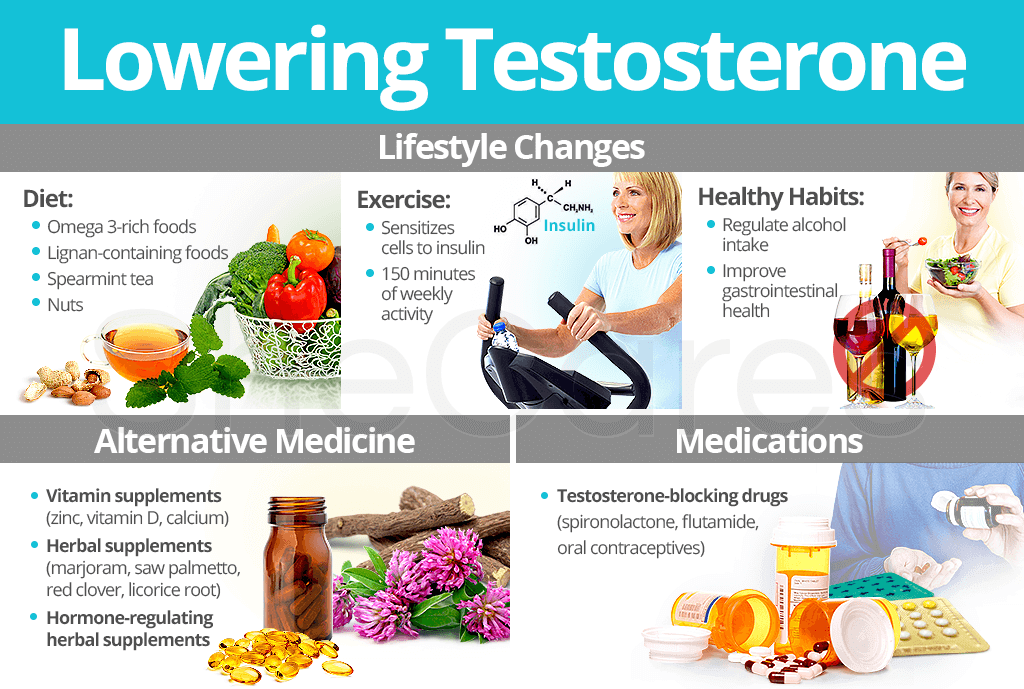
Women suffering from high testosterone levels may feel backed up against a wall in terms of how to deal with the hormonal imbalance. With frustrating symptoms and only prescriptions offered as help from the doctors, any sort of solution involving less risky relief may be welcome.
Find out more about how to lower testosterone levels naturally to finally get back to being the lively, hormonally balanced woman you were before.
Lifestyle Changes to Lower Testosterone
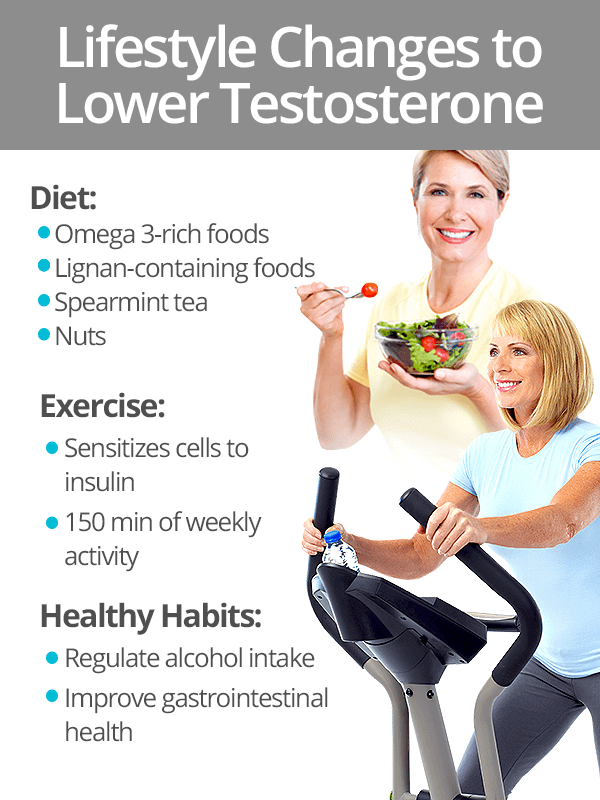
Making changes in diet, exercise routines, and habits can bring positive effects to endocrine system health, ultimately balancing testosterone levels and improving overall well-being.
Diet
Women who are attempting to lower testosterone through dietary measures should try to consume a rich variety of unprocessed foods in addition to:
Omega 3 fatty acids. Recent studies have found that omega-3 supplementation could reduce testosterone level concentrations and regulate menstrual cycles in women suffering from polycystic ovary syndrome (PCOS), a common endocrine disorder characterized by high testosterone levels. High concentrations of omega 3s can also be found in the following foods: cold-water fatty fish (salmon, mackerel, tuna, sardines); nuts and seeds (flaxseed, chia seeds, walnuts); plant oils, like flaxseed oil; and fortified foods of yogurts, milks, soy beverages, and more.
Spearmint tea. Current research suggests that spearmint tea has anti-androgenic properties in women suffering from excessive hair growth, also known as hirsutism. Consuming spearmint tea twice a day has been shown to bring about a significant reduction in free and total testosterone levels.
Lignan-containing foods. These polyphenols have been shown to increase levels of sex hormone binding globulin (SHBG), a protein that binds to testosterone. They may also hinder the production of an enzyme responsible for converting testosterone into dihydrotestosterone (DHT), a more active and potent form that contributes to hormonal hair loss. Lignans are found in broccoli, cauliflower, kale, flaxseed, rye, buckwheat, millet, oats, barley, corn, rice, and wheat.
Nuts. Similar to lignans, nuts - specifically walnuts and almonds - are shown to increase the levels of SHBG in women with PCOS, leading to a decrease in the amount of free testosterone circulating in a woman's body.
Flaxseed. Aside from being heart healthy, research studies have acclaimed flaxseeds for having the ability to lower total and free testosterone levels in women due to its high lignan and omega-3 content. In turn, this decrease in testosterone levels led to improved hirsutism in women.
Exercise
Many women suffering from high androgen and testosterone levels would do well in starting an exercise routine in attempt to sensitive cells to insulin, especially those who are obese. Increased insulin levels in the bloodstream can stimulate the ovaries to produce more testosterone. Therefore, it is recommended to participate in 150 minutes of activity weekly, adding high-intensity exercise and weight training into the mix to maintain a healthy libido and muscle mass.
Healthy habits
Maintaining healthy habits is essential in trying to lower testosterone levels naturally.
- Regulate alcohol intake. Research points to significantly higher total testosterone levels after alcohol intake in premenopausal women. There also appears to be increased rate of conversion from androstenedione - an androgen precursor - to testosterone in the liver after alcohol consumption.
- Improve gastrointestinal health. Testosterone is metabolized by the liver and then excreted from the body in urine. Accordingly, poor gastrointestinal health can obstruct excretion and encourage reabsorption of the hormone. Consume adequate amounts of fiber and probiotics to support an environment conducive to the growth of good gut bacteria.
These lifestyle changes may have a positive effect on balancing hormones holistically. However, they do not directly decrease testosterone levels like some alternative medicines do.
Alternative Medicine to Lower Testosterone
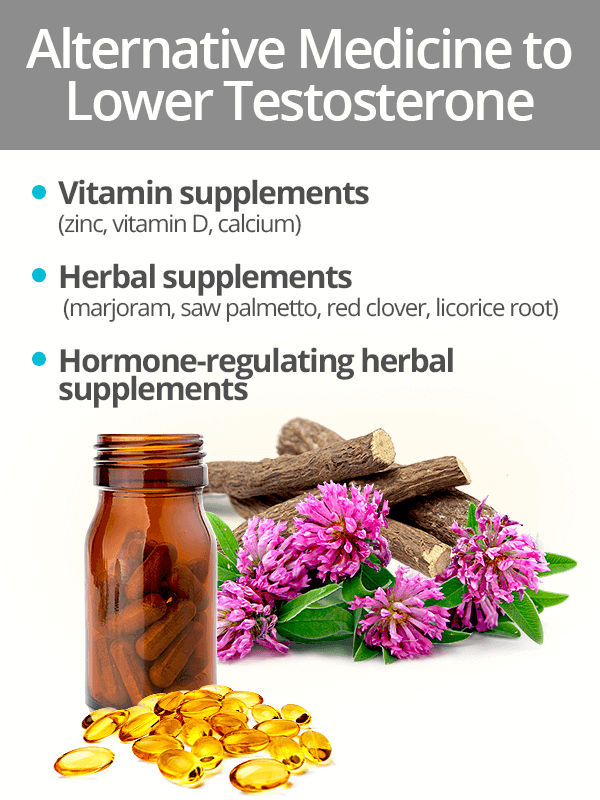
Alternative medicines often involve little to no risk and can be viewed as an effective way to decrease testosterone in women when used appropriately. Common alternative medicine options are vitamin supplements, herbal supplements, and hormone-regulating herbal supplements.
Vitamin supplements
Anti-inflammatory zinc has proven successful in women with PCOS in relieving symptoms of alopecia and hirsutism. The vitamin nourishes the ovaries to promote ovulation and prevents the conversion of testosterone to its stronger form, DHT.
Also, supplementation of vitamin D and calcium for women with PCOS has proven beneficial for regulating menstrual cycles and ovulation. However, further research may be needed to establish the impact of vitamin D supplementation on the management of the endocrine disorder as a whole.
Herbal supplements
Various herbal supplements are acclaimed to lower testosterone and DHT levels in addition to other adrenal androgens in women. These herbs include marjoram, saw palmetto, red clover, and licorice root.
Hormone-regulating supplements
Hormone-regulating supplements - such as Macafem - nourish the pituitary and endocrine glands to encourage the production of estrogen and progesterone, which, in turn, helps regulate imbalances of other hormones such as testosterone.
Medications to Lower Testosterone
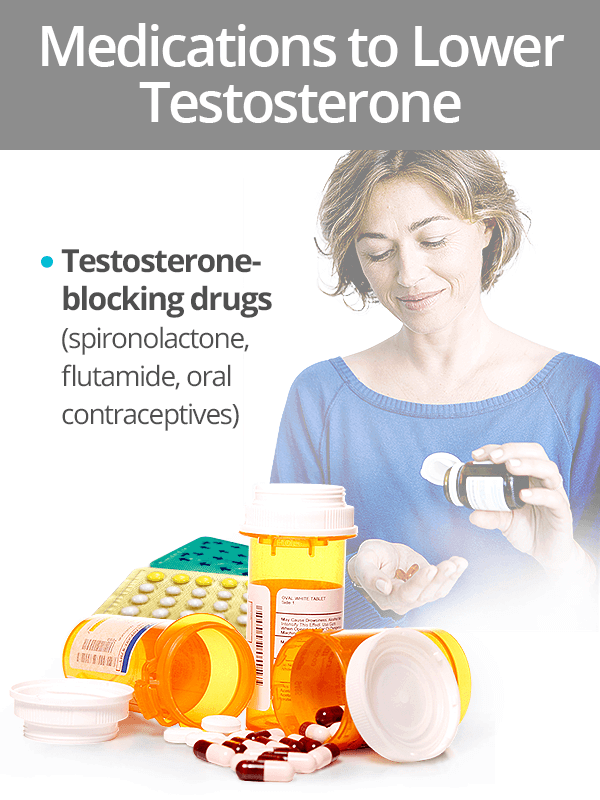
For more drastic cases, pharmaceuticals may be a woman's only option to find relief from high testosterone levels. Keep in mind that they often involve the highest risk and costs.
Testosterone-blocking drugs
The two most common androgen receptor blockers used in the United States are spironolactone and flutamide.
Spironolactone has been used to treat cases of acne and hirsutism in women for over 30 years. It acts by competing with androgen receptors as well as inhibiting androgen synthesis of androstenedione to testosterone and testosterone to DHT. It also works to increase levels of SHBG.
On the other hand, flutamide has proven effective in treating acne, hirsutism, and androgenic alopecia in women. It works by enhancing androgen metabolism to inactive metabolites that are then excreted from the body.
Moreover, oral contraceptives that suppress ovarian androgen production are also prescribed to lower testosterone levels by inhibiting the conversion of testosterone to DHT, thus decreasing sebum production, and increasing SHBG levels. They are mainly prescribed to those who are also interested in reaping the benefits of birth control.
Key Takeaways
Rest assured that natural symptom relief from high testosterone levels is possible with lifestyle changes scientifically backed to lower the sex steroid hormone. Women should optimize their diet with omega 3 fatty acids, spearmint tea, lignan-containing foods, and nuts as well as exercise regularly to increase insulin sensitivity. They should also partake in healthy habits of monitoring alcohol consumption and striving to improve gut health. Alternative medicines used to lower testosterone include a mix of vitamin, herbal, and hormone-regulating supplements. Then, a pharmaceutical treatment plan of testosterone-blocking drugs may be instilled if all else fails.
A persistent desire to improve one's hormonal health and willingness to do the best for one's body is all that's needed to find the best way to lower testosterone levels once and for all.
Sources
- American Cancer Society. (2017). Physical Activity Cancer Fact Sheet. Retrieved November 16, 2018, from https://www.cancer.org/content/dam/cancer-org/cancer-control/en/booklets-flyers/physical-activity-and-cancer-fact-sheet.pdf
- Armanini, D. et al. (2004). Licorice reduces serum testosterone in healthy women. Steroids, 69(1), 763-766. Retrieved November 19, 2018, from https://www.ncbi.nlm.nih.gov/pubmed/15579328
- Ebede, T.L. et al. (2009). Hormonal Treatment of Acne in Women. The Journal of Clinical and Aesthetic Dermatology, 2(12), 16/22. Retrieved November 16, 2018, from https://www.ncbi.nlm.nih.gov/pmc/articles/PMC2923944/
- Grant, P. (2010). Spearmint herbal tea has significant anti-androgen effects in polycystic ovarian syndrome. A randomized controlled trial. Phytotherapy Research: PTR, 24(2), 186/188. doi: 10.1002/ptr.2900.
- Jamilian, M. et al. (2016). Effects of Zinc Supplementation on Endocrine Outcomes in Women with Polycystic Ovary Syndrome: a Randomized, Double-Blind, Placebo-Controlled Trial. Biological Trace Element Research, 170(2), 271-278. doi: 10.1007/s12011-015-0480-7.
- Kalgaonkar, S. et al. (2011). Differential effects of walnuts vs almonds on improving metabolic and endocrine parameters in PCOS. European Journal of Clinical Nutrition, 65(3), 386/393. doi: 10.1038/ejcn.2010.266.
- Lin, M. & Wu, M. (2015). The role of vitamin D in polycystic ovary syndrome. Indian Journal of Medical Research, 142(3), 238-240. doi: 10.4103/0971-5916.166527
- Nadjarzadeh, A. et al. (2013). The effect of omega-3 supplementation on androgen profile and menstrual status in women with polycystic ovary syndrome: A randomized clinical trial. Iranian Journal of Reproductive Medicine, 11(8), 665/672. Retrieved November 16, 2018, from https://www.ncbi.nlm.nih.gov/pmc/articles/PMC3941370/
- National Institutes of Health: Office of Dietary Supplements. (2018). Omega-3 Fatty Acids. Retrieved November 16, 2018, from https://ods.od.nih.gov/factsheets/Omega3FattyAcids-Consumer/
- Nowak, D.A. et al. (2007). The Effect of Flaxseed Supplementation on Hormonal Levels Associated with Polycystic Ovarian Syndrome: A Case Study. Current Topics in Nutraceutical Research, 5(4), 177/181. Retrieved November 19, 2018, from https://www.ncbi.nlm.nih.gov/pmc/articles/PMC2752973/
- Sarkola, T. et al. (2000). Acute effect of alcohol on androgens in premenopausal women. Alcohol and Alcoholism (Oxford, Oxfordshire), 35(1), 84/90. Retrieved November 16, 2018, from https://www.ncbi.nlm.nih.gov/pubmed/10684783