What is Progesterone?
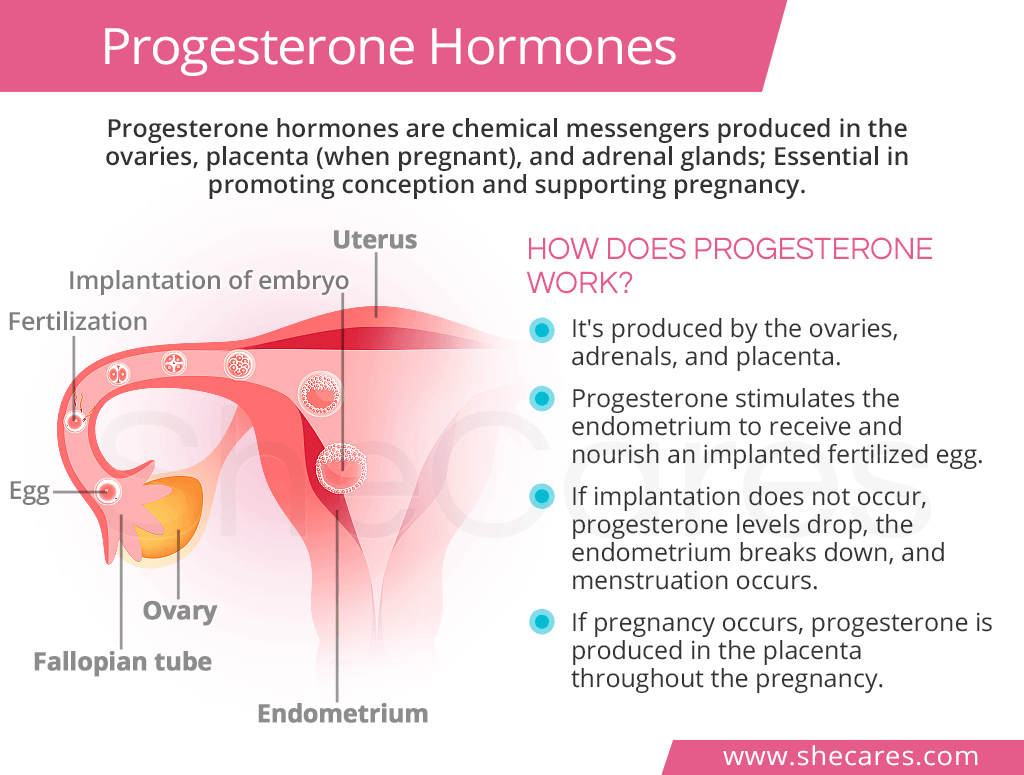
Progesterone is a major progestational steroid hormone that predominantly helps prepare the uterus for a fertilized egg and maintain pregnancy.
There are two main types of progesterone: steroidal and non-steroidal. Steroidal progesterone hormones are endogenous and created from cholesterol. Non-steroidal progesterone hormones are synthetically produced and often used for birth control and HRT. Although manufactured in laboratories, they have an equivalent impact on health.
Click on the following link to find out more about different types of progesterone to begin to understand its complex role within the female body.

Progesterone Production
Progesterone production changes its sites based on stage of the menstrual cycle. In nonpregnant women, the majority of progesterone is produced in the adrenal glands before ovulation and in the ovaries after ovulation. If the egg is fertilized, progesterone production eventually moves to the placenta.
Once produced and secreted, progesterone is transported throughout the body in the blood, binding to hormone receptor sites and influencing cell behavior. This can either positively or negatively affect a woman's health.
Discover more about progesterone production for a heightened understanding of the hormone's numerous origins.
Progesterone Function
Many women associate progesterone strictly with fertility and pregnancy. However, the hormone contributes to maintaining overall health, too.
The array of roles that progesterone carries out in women includes:
- Producing calming effects in the brain
- Helping retain bone density
- Supporting cardiovascular health
- Modulating immune system activity
- And more
Learn more about progesterone roles and effects, including specific side effects evoked by high and low progesterone levels on various organs.

Progesterone Fluctuations through Life
Progesterone hormones play a crucial role in women's lives, beginning with puberty and continuing until after reproductive years. Click on the following link to find out more about progesterone fluctuations through life, or continue reading for specifics about significant life stages that render considerable hormonal variances.
Progesterone during the Menstrual Cycle
Progesterone is one of the most important hormones needed to make conception happen. Progesterone serves to maintain the thickened lining of the uterus in preparation for a fertilized egg and prohibits uterine muscle contractions that would cause the body to reject an egg. To learn more about progesterone during the menstrual cycle, click the preceding link.
Progesterone and Pregnancy
Throughout a pregnancy, high levels of progesterone are required until parturition to fulfill a variety of responsibilities. The hormone helps establish the placenta and correctly develop the fetus; withholds lactation until post-partum; strengthens the pelvic wall muscles; and much more. To learn more about the hormone's paramount role in pregnancy, read all about progesterone and pregnancy.
Progesterone and Menopause
When a woman is in perimenopause, there is a natural decline in ovarian progesterone production, and anovulation or oligoovulation can ensue. This production drops drastically with the onset of menopause as the hormone is produced in lesser amounts elsewhere in the body. Learn more about the effects induced in a woman's body concerning progesterone and menopause here.
Progesterone Levels
It is imperative that women maintain normal progesterone levels due to the hormone's vast involvement in multiple organs.
During adulthood, normal progesterone levels range from 0.1 - 25 ng/mL.1 As with estrogen, the consistent rise and fall of progesterone levels occurs throughout monthly menstruation. Progesterone levels adapt accordingly during significant life stages, such as pregnancy and postmenopause.
Click on the following link to read more about the importance of normal progesterone levels and possible complications associated with the hormone's imbalance.
Low Progesterone Levels Causes
It is not uncommon for women to experience abnormal fluctuations of progesterone at some point in their lives.
Low progesterone in women can be caused by a variety of circumstances, including natural incidences, lifestyle factors, induced causes, and other conditions.
Read more about low progesterone levels and causes to have a better understanding of what can lead to the hormonal influx.
Signs and Symptoms of Low Progesterone Levels
Signs and symptoms of low progesterone levels can be subtle, making treatment tricky. The most common indications that progesterone is low include headaches, breast tenderness, bloating, and many more.
Click on the attached link to discover more about signs and symptoms of low progesterone levels before the imbalance turns into a serious, irreversible health concern.
Increasing Progesterone Levels
There are several options women can pursue to increase progesterone levels once a hormonal imbalance diagnosis is made.
Some lifestyle changes that help increase progesterone levels include an improved diet, moderate exercise, and wholesome habits. Alternative medicine and medical treatments can also be used to stabilize the intricate balance between hormones.
Continue reading to learn all about how to increase progesterone levels and get back on track to better health.
High Progesterone Levels Causes
Too much progesterone in the body can be due to periods of reproductive significance - such as pregnancy - and lifestyle factors, including smoking and caffeine.
Similarly to low progesterone levels, high progesterone levels can also be induced by treatments, medications, and environmental exposures as well as other conditions.
Discover more about high progesterone levels and causes to prevent the imbalance from occurring.
Signs and Symptoms of High Progesterone
Furthermore, when progesterone levels surge, a plethora of symptoms typically associated with the menopausal transition follows. These symptoms can evolve into serious conditions if left untreated.
Click on the following link to learn all about high progesterone signs and symptoms for a heightened awareness on what to look out for in wake of this disequilibrium.
Progesterone Deficiency
A progesterone deficiency is not solely defined as low progesterone levels, but a state when a woman has consistently low progesterone levels due to high estrogen presence in the body, otherwise known as estrogen dominance.
A permanent state of progesterone deficiency, regardless of the hormone's monthly fluctuation, is often caused by health problems, environmental pollutants, and exogenous hormones. Also, there are various risk factors that make women more susceptible to this condition, too.
Click on the following link to learn more about the causes, risk factors, symptoms, signs, and more concerning a progesterone deficiency.

Progesterone Tests
In general, progesterone tests are used to explore a variety of menstrual abnormalities throughout a woman's reproductive life, such as unusual spotting and amenorrhea among others.
Common progesterone tests include blood and urine tests, and more advanced tests include saliva tests. Critics claim that each boasts advantages and disadvantages.
Continue reading to learn more about progesterone tests, including the best time to take each for optimum results.

Progesterone Medications & Products
Aside from lifestyle changes and natural treatments used to remedy hormonal imbalances, there are an array of progesterone medications that may be employed to hasten the treatment process. Discover more information about when and how to take progesterone medications, or continue on to the next sections for specifics about each.
Progesterone Creams
Synthetic progesterone creams are used to treat hormonal imbalances and alleviate disorders, such as estrogen dominance and infertility. Progesterone creams are for short or long-term use and should be directly applied to areas of thin skin for maximum absorption. Read more about progesterone creams, including their benefits and side effects.
Progesterone Pills
Progesterone pills - also known as progesterone tablets - are predominantly used as oral contraceptives. However, certain brands of progesterone pills are also used to alleviate symptoms of hormonal imbalances, like PMS. They are generally ingested on a daily basis. Discover more about progesterone pills and their benefits and side effects.
Progesterone Suppositories
Progesterone suppositories are solid unit dosages intended for insertion into body orifices, namely the vagina or rectum. Once inserted, they release the hormone progesterone over a prolonged period of time, steadily easing hormonal irregularities. Read more about progesterone suppositories and their benefits and side effects by clicking on the preceding link.
Progesterone Injections
Progesterone injections are commonly used as a type of fertility treatment or birth control in addition to treating hormone deficiencies. The shots are injected into a muscle once a day or once every three to four months, depending on the reason for use. Find out all the details on progesterone injections, including benefits, side effects, and when and how to use them.
Safety and Side Effects of Progesterone Medications
Side effects of progesterone medications occur when too much progesterone is introduced into the body, whether that be orally, topically, or via insertion. Then, when glands become saturated, symptoms of high progesterone levels ensue.
Find out more about the safety and side effects of progesterone medications.
Progesterone Supplements
Although pharmaceutical options may reap quick results, they are often considered riskier due to unwanted and possibly serious side effects.
Fortunately, there are a variety of natural progesterone treatments - including herbal supplements – available for women searching to amend a progesterone deficiency without medications.
Read more to find out more about natural progesterone treatments for a path to overall health.
Sources
- Brinton, R.D. et al. (2008). Progesterone receptors: form and function in brain. Frontiers in Neuroendocrinology, 29(2), 313-339. doi: 10.1016/j.yfrne.2008.02.001
- Cleveland Clinic. (2017). Hormone Therapy. Retrieved December 20, 2019, from https://my.clevelandclinic.org/health/treatments/15245-hormone-therapy
- Hormone Health Network. (2017). What is Progesterone? Retrieved December 20, 2019, from http://www.hormone.org/hormones-and-health/hormones/progesterone
- NHS. (2015). Girls and puberty Q&A. Retrieved December 20, 2019, from http://www.nhs.uk/Livewell/Sexandyoungpeople/Pages/Girlspuberty.aspx
- The North American Menopause Society. (2010). Changes in Hormone Levels. Retrieved December 20, 2019, from https://www.menopause.org/for-women/sexual-health-menopause-online/changes-at-midlife/changes-in-hormone-levels
- PubChem: Open Chemistry Database. (n.d.). Progesterone. Retrieved December 20, 2019, from https://pubchem.ncbi.nlm.nih.gov/compound/progesterone#section=Top
- Society of Endocrinology. (2015). Progesterone. Retrieved December 20, 2019, from http://www.yourhormones.info/Hormones/Progesterone.aspx
- Tulane University. (n.d.). Endocrine System: Types of Hormones. Retrieved December 20, 2019, from http://e.hormone.tulane.edu/learning/types-of-hormones.html
- U.S. Department of Health and Human Services. (2017). Progesterone. Retrieved December 20, 2019, from https://medlineplus.gov/druginfo/meds/a604017.html
- Women in Balance Institute: National University of Natural Medicine. (n.d.). Progesterone and the Nervous System/Brain | Progesterone & Cardiovascular Health. Retrieved December 20, 2019, from https://womeninbalance.org/resources-research/progesterone-and-the-nervous-systembrain/ | https://womeninbalance.org/resources-research/progesterone-cardiovascular-health/
Footnotes:
- University of Rochester Medical Center: Healthy Encyclopedia. (n.d.). Progesterone. Retrieved December 20, 2019, from https://www.urmc.rochester.edu/encyclopedia/content.aspx?ContentTypeID=167&ContentID=progesterone