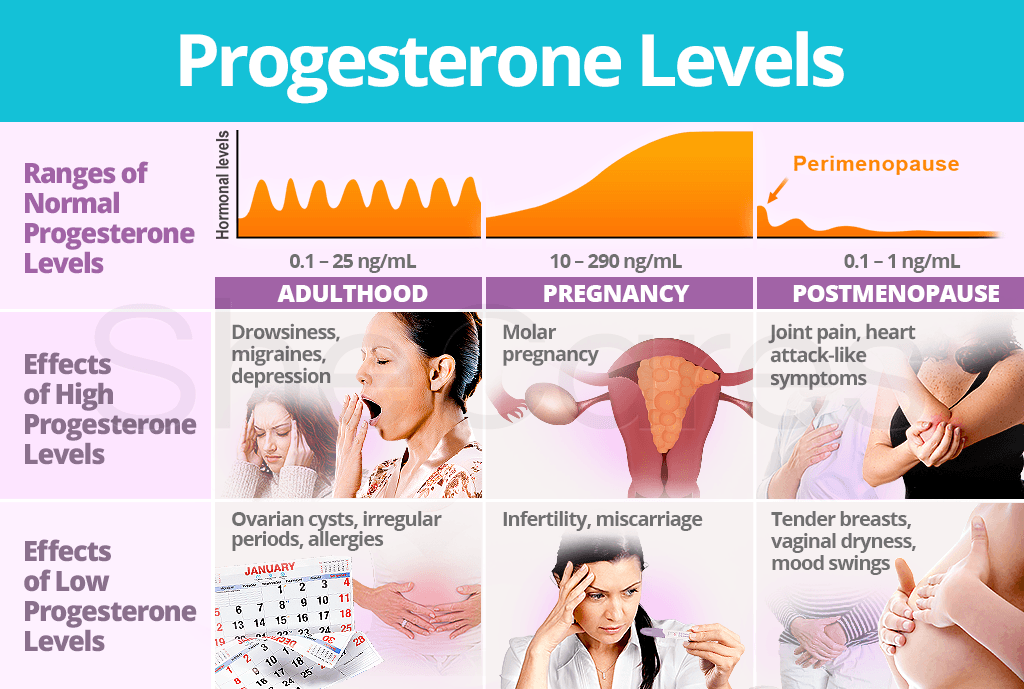
Because it contributes to the well-being of the brain, heart, immune system, and more, sustaining healthy progesterone levels is crucial. Continue reading to learn more about normal progesterone levels and its dire importance in the female body, including the negative side effects of an imbalance.
Ranges of Normal Progesterone Levels
Average Daily Progesterone Levels
- Puberty
- Adulthood
- Pregnancy
- Postmenopause
This table shows the average daily progesterone levels for a woman at varying times during and after her reproductive years. Measurements are taken from blood serum and provided in ng/mL (nanograms/milliliter), and measured levels can fluctuate depending on the type of test taken.
During adulthood
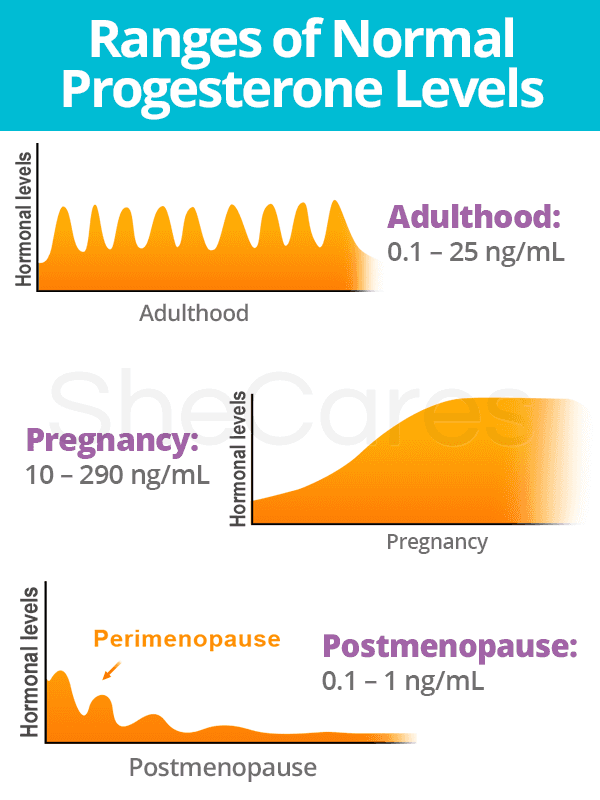
A woman of reproductive age will have daily progesterone levels ranging from 0.1 - 25 ng/mL. Progesterone is lower during the first half of the menstrual cycle and rises during the second half after ovulation, only for the cycle to repeat again if conception didn't occur.
During pregnancy
Healthy progesterone levels can range between 10 - 290 ng/mL. Progesterone levels will begin to rise steadily starting around the ninth week of pregnancy and will continue increasing until around the 32nd week. Progesterone production switches from the corpus luteum to the placenta around the 12th week.
During postmenopause
Daily progesterone levels after menopause will usually hover between 0.1 - 1 ng/mL. Since the corpus luteum created from the ruptured follicle after ovulation is the main contributor of progesterone, levels plunge when menstrual cycles end. With treatment, levels can increase to premenopausal numbers.
Importance of Normal Progesterone Levels
As aforementioned, the effects of healthy progesterone levels span far beyond the female reproductive system. The following are just a few examples of progesterone's contributions to overall health.
During Adulthood
- Protects the cervix from ascending infection
- Increases endometrial receptivity for embryo implantation
- Modulates inflammation to support healthy immunity
During Pregnancy
- Prepares the breasts for milk production
- Prevents the body from ovulating
- Helps maintain the pregnancy
During Postmenopause
- Produces calming, anti-anxious, and memory-enhancing effects
- Safeguards the brain from damage
- Assists estrogen with maintaining bone mass
- Lowers blood pressure
- Helps prevent the onset of breast, endometrial, and ovarian cancer
Keep in mind that even though many of the aforementioned effects are in sections, many occur throughout life no matter one's reproductive stage.
Read more about progesterone's role and effects for a heightened understanding of the breadth of the hormone's impact in the female body.
What Happens When Progesterone Levels are High?
Current progesterone levels are largely dependent of age, current stage of the menstrual cycle, and other factors, such as habits that could be encouraging a state of hormonal imbalance.
Nonetheless, a progesterone imbalance in which levels are abnormally high or low can provoke various negative effects.
During adulthood
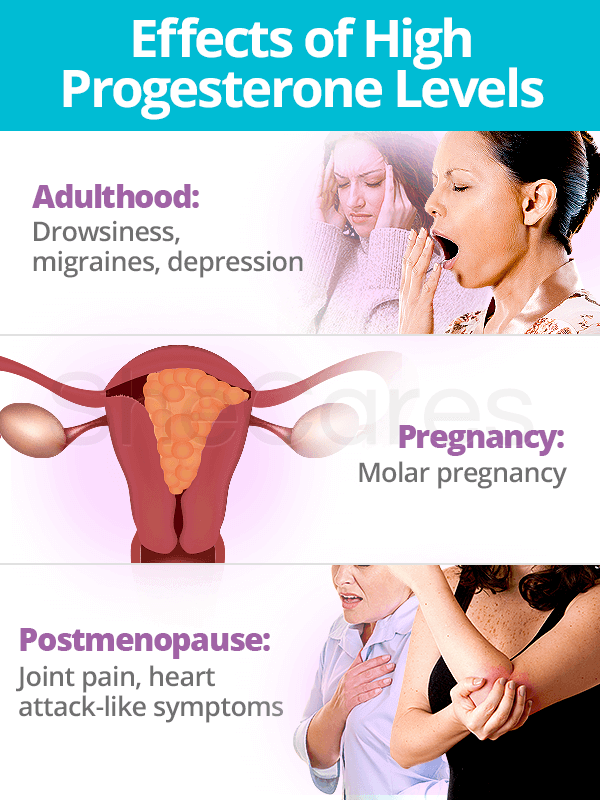
Excess progesterone can cause drowsiness, insomnia, headaches, migraines, depression, anxiety, and changes in appetite. Women may also experience vaginal dryness, itchiness, and swelling due a reduction in and thickened vaginal secretions.
Moreover, high progesterone levels can lead to breast tenderness and scantier, longer menstrual periods with abnormal spotting between cycles.
During pregnancy
Abnormally high progesterone levels during a pregnancy could signify the presence of a molar pregnancy, which causes abnormal uterine tissue growth due to a genetic error. With a molar pregnancy, the fetus doesn't form properly in the womb, preventing further baby development.
During postmenopause
Postmenopausal women who suffer from high progesterone levels may also experience joint pain with accompanied muscle aches.
In addition, with a buildup of progesterone in fatty tissues, hormone receptor sites can eventually stop functioning. This can cause an over-stimulatory effect by estrogen - now unopposed with ineffective progesterone - and adversely affect the heart, inducing heart attack-like symptoms.
Read more information about high progesterone levels, including its signs and symptoms.
What Happens When Progesterone Levels are Low?
During adulthood
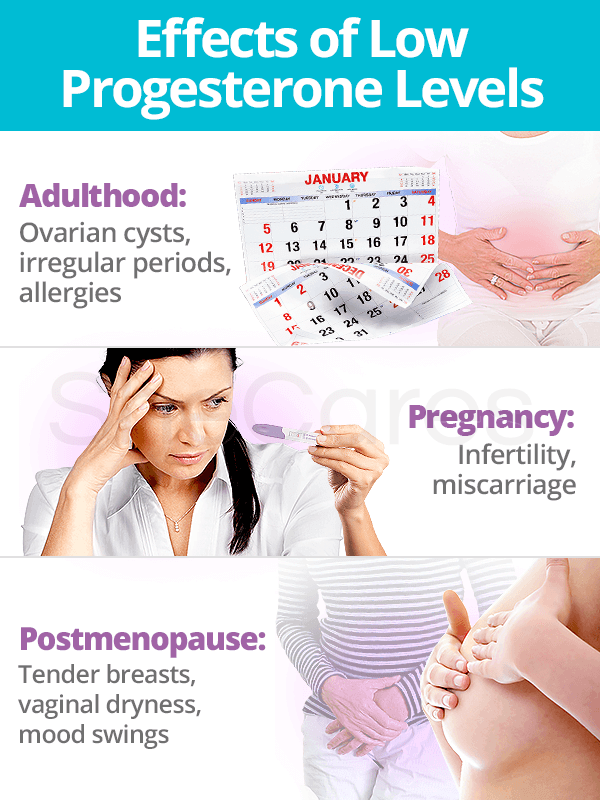
Low progesterone levels may lead to ovarian cysts, which are characteristic of polycystic ovarian syndrome (PCOS), with non-proportional estrogen-progesterone levels. Low progesterone can also lead to frequent, heavy periods or an absence of periods.
Likewise, a hormone imbalance may weaken immune and circulatory system functions. In this case, allergies can arise, causing hives, rashes, and other skin conditions.
During pregnancy
Low progesterone levels can lead to a condition known as luteal phase defect, in which there is an improper endometrial lining for embryo implantation. This could cause infertility or miscarriage.
Moreover, some women are known to experience mood changes associated with low levels of progesterone postpartum.
During postmenopause
Estrogen levels may dominate those of progesterone after menstrual years, causing tender and cystic breasts. Often times, vaginal dryness will also occur alongside abnormal vaginal bleeding. The latter can be triggered by the onset of endometrial cancer.
Additionally, low progesterone levels may be associated with bone loss. And similar to post-partum, low levels of the hormone during the menopausal transition can trigger mood swings and increased anxiety.
To resolve any ambiguities in regards to progesterone balance and its impact on well-being, continue reading to learn more about low progesterone levels and its causes.
Sources
- Aschenbrenner, D. S. & Venable, S.J. (2009). Drug Therapy in Nursing. Philadelphia: Lippincott Williams & Wilkins. Available from Google Books.
- Carp, H.J. (Ed.). (2015). Progestogens in Obstetrics and Gynecology. Switzerland: Springer International Publishing. Available from Google Books.
- Chiras, D.D. (2015). Human Biology. Massachusetts: Jones & Bartlett Learning. Available from Google Books.
- Coad, J. & Dunstall, M. (2005). Anatomy and Physiology for Midwives. United Kingdom: Elsevier. Available from Google Books.
- Crockett, L. (2009). Healing Our Hormones, Healing Our Lives. UK: John Hunt Publishing Ltd. Available from Google Books.
- Cutillo, D.M. (2012). The Hormone “Shift”: How to Resolve Issues with your Mood, Weight & Health. Indiana: Balboa Press. Available from Google Books.
- Davey, J.D. & Dzugan, S.A. (2017). The Cholesterol Puzzle: The Hormone Connection. United Kingdom: Matador. Available from Google Books.
- Hormone Health Network. (n.d.). What is Progesterone? Retrieved October 23, 2017, from http://www.hormone.org/hormones-and-health/hormones/progesterone
- Matzuk, M. et al. (Eds.). (2001). Transgenics in Endocrinology. New Jersey: Humana Press. Available from Google Books.
- Seifert-Klauss, V. & Prior, J.C. (2010). Progesterone and Bone: Actions Promoting Bone Health in Women. Journal of Osteoporosis, 2010: 845180. doi: 10.4061/2010/845180
- Thomas, P. & Pang, Y. (2013). Protective actions of progesterone in the cardiovascular system: potential role of membrane progesterone receptors (mPRs) in mediating rapid effects. Steroids, 78(6), 583-588. doi: 10.1016/j.steroids.2013.01.003
- University of Rochester Medical Center: Healthy Encyclopedia. (n.d.). Progesterone. Retrieved October 19, 2017, from https://www.urmc.rochester.edu/encyclopedia/content.aspx?ContentTypeID=167&ContentID=progesterone
- Women in Balance Institute: National University of Natural Medicine. (n.d.). Progesterone and the Nervous System/Brain | Progesterone & Cardiovascular Health. Retrieved October 23, 2017, from https://womeninbalance.org/resources-research/progesterone-and-the-nervous-systembrain/ | https://womeninbalance.org/resources-research/progesterone-cardiovascular-health/