Just as progesterone levels can fall below desired levels, the opposite is also true, and high progesterone levels' repercussions can be just as harmful to a woman's mental and physical health if unmanaged.
Therefore, to begin living an improved quality of life, continue reading to learn more about high progesterone levels and its causes.
About High Progesterone Levels
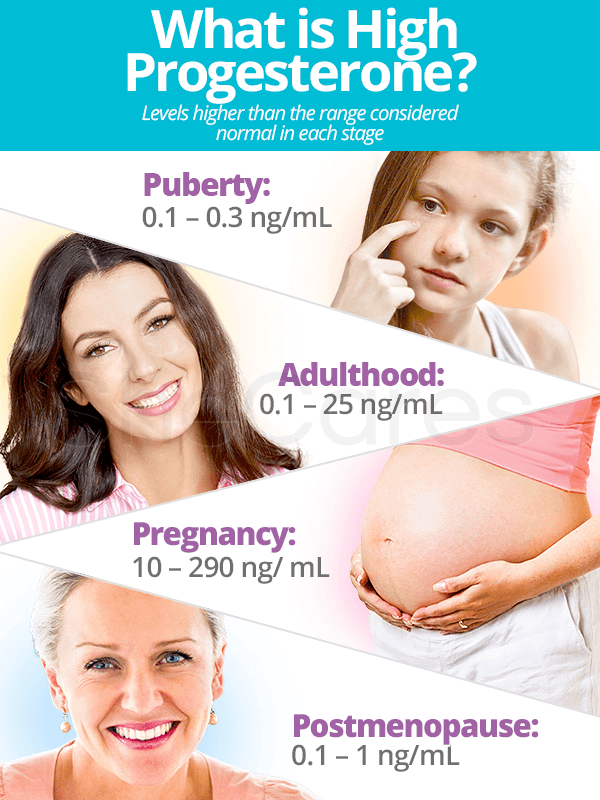
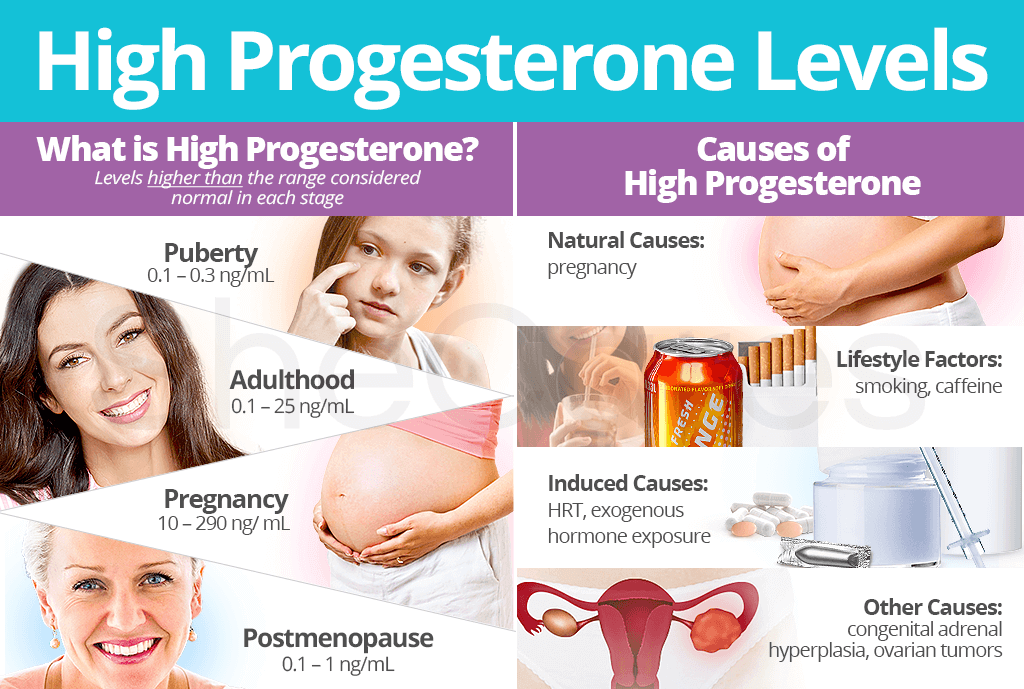
Throughout a woman's life, it is normal for monthly progesterone levels to range from 0.1 - 25 ng/mL, depending upon age and stage in the menstrual cycle.1
The presence of excess progesterone is commonly believed to be caused strictly by excessive administration of or supplementation with progesterone products. However, abnormal variations can be caused by a number of factors.
Causes of High Progesterone Levels
Many cases of high progesterone levels are reported in otherwise healthy women over the age of 35. Oftentimes, women who experience high levels of progesterone assume the symptoms are due to the menopause transition, which is when hormonal fluctuations are known to occur. With this misconception in mind, they leave the imbalance untreated.
In other instances, these women incorrectly interpret their progesterone surge as a deficiency, eventually exacerbating the condition by augmenting the amount of the hormone within the body.
Fortunately, by understanding the causes of high progesterone levels, it is possible to overcome them.
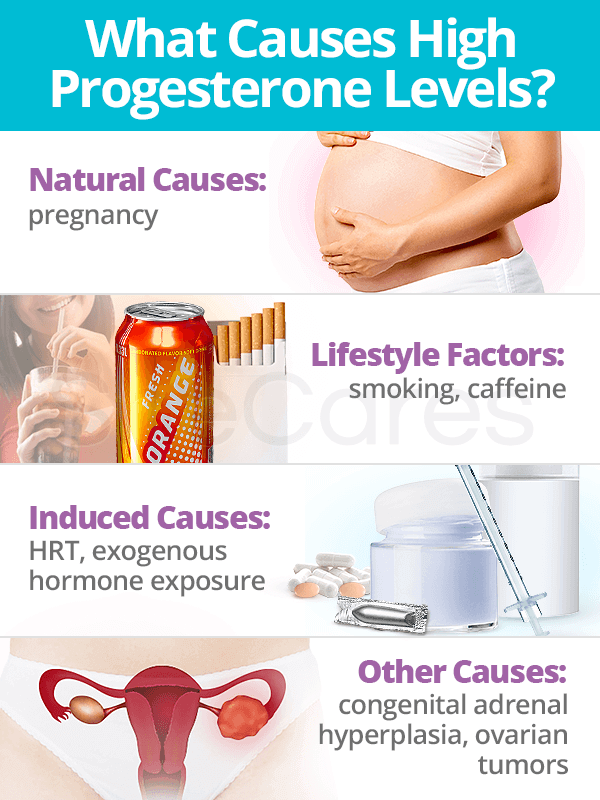
Natural Causes of High Progesterone Levels
During Adulthood (20s to 40s)
Naturally, progesterone should be highest during the second half of the menstrual cycle as it is produced by the corpus luteum, a temporary structure that evolves after ovulation. This progesterone is used to maintain the uterine lining.
If conception doesn't occur, the uterine lining sheds during menstruation, only for the cycle to begin again. However, if conception does occur with pregnancy, the corpus luteum will continue to produce progesterone until the placenta takes over production around the tenth week of gestation.2
If suspicion of a progesterone imbalance occurs before the normal age of menopause, it is advised for women to receive further diagnosis.
Lifestyle Factors that Cause High Progesterone Levels
There are also a few lifestyle factors that can cause elevated progesterone. Some of them include, but are not limited to, the following:
Smoking. Smoking increases adrenal activity. Reported elevated serum progesterone levels have been measured during the early follicular phase of the menstrual cycle in premenopausal women who smoke, which is when most of the progesterone produced originates from the adrenal glands.3
Caffeine. Studies have shown a trend for high circulating progesterone levels with the consumption of excessive caffeine, but not with coffee intake.4
Induced Causes of High Progesterone Levels
Various treatments, medications, and environmental exposures can cause women to have elevated progesterone levels, including:
Hormone replacement therapy (HRT). After menopause, many women turn to hormone replacement therapy to manage symptoms. However, while receiving HRT, progesterone levels could become fundamentally disproportionate. This could increase a woman's chances of developing symptoms of high progesterone, such as bloating and fluid retention, among others.
Other exogenous hormones. Due to large amounts of estrogens and progesterone present in commercial cow's milk, there is a significant increase in serum estrone and progesterone concentrations in consumers. All types of estrogen and pregnanediol - an inactive metabolic product of progesterone - have also been found in tested consumer urine concentrations.
Other Causes of High Progesterone Levels
Moreover, the following conditions can prompt high progesterone levels in women:
Congenital adrenal hyperplasia. High levels of progesterone are a consequence of an inherited condition known as congenital adrenal hyperplasia. A fetus affected by this condition will produce excessive male hormones during development. For females, this manifests as excessive hair, called hirsutism, and oligomenorrhea due to excess adrenal androgen and progesterone.
Ovarian tumors. Research has found that the presence of ovarian tumors may provoke consistently high progesterone levels.5 Also, recent studies have shown that serum sex steroid levels - of estradiol, progesterone, and testosterone - are significantly higher in postmenopausal women with mucinous ovarian tumors in comparison to other tumor types, such as epithelial-stromal or germ cell.6
Paying attention to hormonal levels is important before conditions develop into more serious complications. Continue reading to learn more about the signs and symptoms of high progesterone to catch the imbalance in its tracks.
Sources
- Carlson, K.J. et al. (2004). The New Harvard Guide to Women's Health. Massachusetts: Harvard University Press. Available from Google Books.
- Conrad, C. (2005). A Woman's Guide to Natural Hormones. New York: Penguin Group. Available from Google Books.
- Cleveland Clinic. (n.d.). Bioidentical Hormones. Retrieved November October 17, 2019, from https://my.clevelandclinic.org/health/articles/bioidentical-hormones
- Davey, J.D. & Dzugan, S. (2015). The Menopause Cure and Hormonal Health. UK: Matador. Available from Google Books.
- Dessinioti, C. & Katsambas, A. (2009). Congenital adrenal hyperplasia. Dermatoendocrinology, 1(2), 87-91. doi: 10.4161/derm.1.2.7818
- Kawarai, Y. et al. (2017). High serum progesterone associated with infertility in a woman with nonclassic congenital adrenal hyperplasia. The Journal of Obstetrics and Gynaecology Research, 43(5), 946-950. doi: 10.1111/jog.13288
- Maruyama, K. et al. (2010). Exposure to exogenous estrogen through intake of commercial milk produced from pregnant cows. Pediatrics International: Official Journal of the Japan Pediatric Society, 52(1), 33-38. doi: 10.1111/j.1442-200X.2009.02890.x
- Project AWARE. (2008). What Hormones are Used in HRT? Retrieved October 17, 2019, from https://www.project-aware.org/Managing/Hrt/whathormones.shtml
- Society of Endocrinology. (2018). Progesterone. Retrieved October 17, 2019, from https://www.yourhormones.info/hormones/progesterone/
Footnotes:
- University of Rochester Medical Center: Healthy Encyclopedia. (n.d.). Progesterone. Retrieved October 17, 2019, from https://www.urmc.rochester.edu/encyclopedia/content.aspx?ContentTypeID=167&ContentID=progesterone
- Society of Endocrinology. (n.d.). Hormones of pregnancy and labour. Retrieved October 17, 2019, from http://www.yourhormones.info/topical-issues/hormones-of-pregnancy-and-labour/
- Windham, G.C. et al. (2005). Cigarette Smoking and Effects on Hormone Function in Premenopausal Women. Environmental Health Perspectives, 113(10), 1285-1290. doi: 10.1289/ehp.7899
- Kotsopoulos, J. et al. (2009). Relationship Between Caffeine Intake and Plasma Sex Hormone Concentrations in Premenopausal and Postmenopausal Women. Cancer, 115(12), 2765-2774. doi: 10.1002/cncr.24328
- Bry-Gauillard, H. et al. (2005). Primary Amenorrhea Due to Constant High Progesterone Level Revealing a Leydig Cell Ovarian Tumor. Fertility and Sterility, 84(1), S161-S162. doi: 10.1016/j.fertnstert.2005.07.396
- Matsuoka, A. et al. (2016). Elevated serum progesterone levels in postmenopausal women with mucinous ovarian tumors. Menopause, 23(5), 544-549. doi: 10.1097/GME.0000000000000587