Despite familiarity with the progesterone hormone, many women remain uncertain as to what role it performs within the body. In order to make informed decisions about health, understanding what is progesterone and its different types is essential.
What is Progesterone?
Define Progesterone
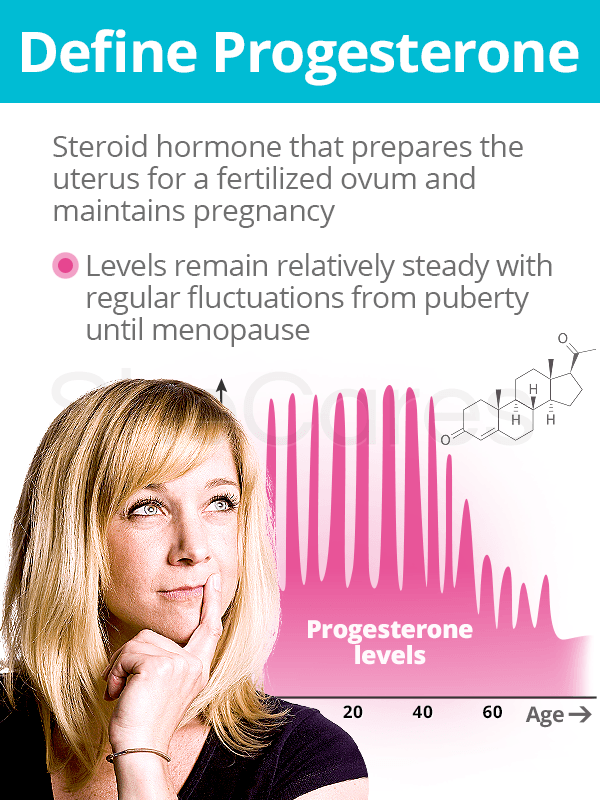
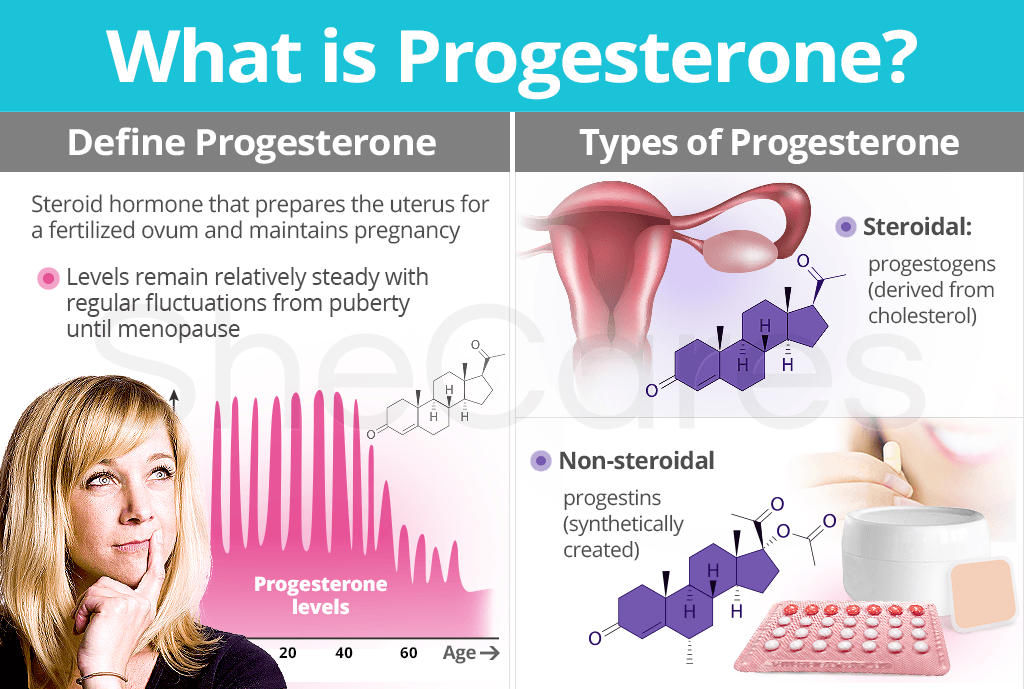
Progesterone is a major progestational steroid hormone that prepares the uterus for a fertilized ovum and maintains pregnancy.
Throughout the menstrual cycle, progesterone is principally secreted by the corpus luteum to prepare the endometrium for implantation.
If conception does not occur, the corpus luteum breaks down and triggers the beginning of the next menstrual cycle. If conception does occur, then the placenta takes control of progesterone secretion to thus prevent the rejection of the developing embryo.
Mainly, progesterone is produced in the ovaries to foster healthy menstruation and by the placenta to support fetal development and pregnancy. The sex hormone is also largely produced in the adrenal glands.
Since progesterone is so intricately involved with a woman's reproductive life, a progesterone imbalance can evoke problems with menstruation and fertility. While different amounts will be produced depending on reproductive stage, maintaining lifelong hormonal balance is essential to overall health.
Progesterone Meaning: Word Origin
Initially, the name progesterone was a blend of progestin and luteosterone (corpus luteum + sterol).
However, now the origin of the word progesterone is claimed to be a combination of a physiological and chemical description: progestational steroidal ketone.
Types of Progesterone
There are two main types of progesterone hormones: natural and synthetic.
Natural, steroidal progesterone hormones are endogenous, originating from within women. Other progesterone hormones are pharmaceutically created and can also be synthetically derived from natural sources, such as plants.
Natural Progesterone
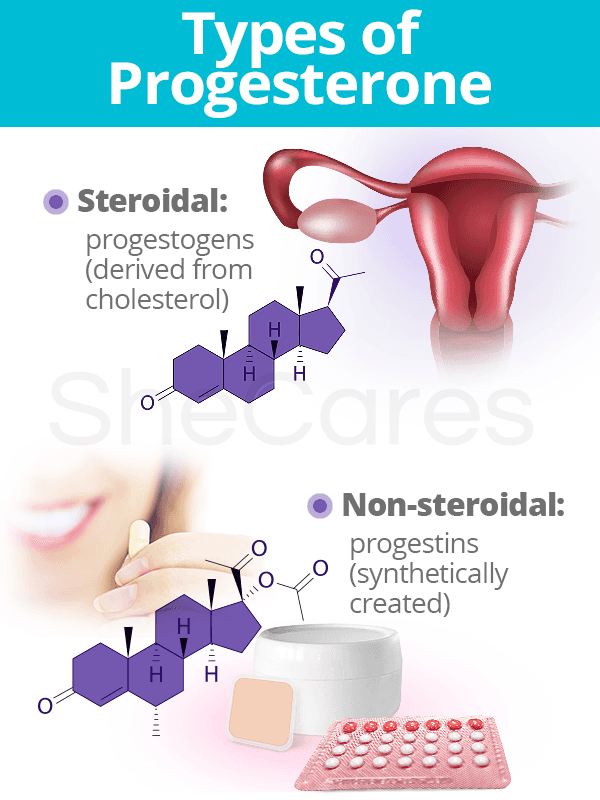
Progesterone is a steroid hormone created from cholesterol that belongs to the progestogens, which are derived from pregnenolone. In fact, progesterone is the only naturally occurring human progestogen.
Pregnenolone is an endogenous steroid hormone that is a principal precursor to other steroid hormones synthesized by the ovaries and adrenal glands. Four major classes of steroids come from pregnenolone: estrogens, progestogens, androgens, and corticosteroids. The first three classes are considered sex steroid hormones.
Keep in mind that progesterone is not to be confused with progestins, which are synthetically produced progestogens.
Progesterone Structure (C21H30O2)
Steroid hormones, such as progesterone, have four cyclic hydrocarbons. Each hydrocarbon is an amalgamation of hydrogen and carbon and is hydrophobic, repelled by water.
Moreover, progesterone consists of ketone and oxygenated functional groups as well as two methyl branches.
Synthetic Progestin Hormones
Progestin hormones are produced in laboratories to have progestogenic activity that triggers effects similar to those of endogenous progesterone.
They are mainly used for birth control and hormone therapy.
Birth Control
Progestin hormones are made to act on the uterus, especially in treatment of dysfunctional uterine bleeding and prevention of endometrial cancer, and the mammary glands before and during pregnancy.
They are available in various forms, including pills; topical applications, such as creams and skin patches; injections into a muscle; or insertions, such as vaginal rings or intrauterine devices.
Progestin-only pills, specifically, are used as contraceptives for women with contraindications to estrogen or for those breastfeeding. Combination oral contraceptive pills with progestin and estrogen are used to reduce androgenic symptoms.
Noted side effects of progestin contraceptives include breakthrough bleeding, nausea, headaches, breast tenderness, acne, mood swings, weight gain, hirsutism, and more.
Hormone Therapy
Synthetic progesterone hormones are also widely used during hormone replacement therapy (HRT), a treatment geared to alleviate symptoms caused by a hormonal deficiency.
However, because of many reported side effects of HRT, interest in replicating the progesterone hormone for clinical use from natural sources has ensued, thus birthing bioidentical hormones.
Natural progesterone, also called bioidentical progesterone, is synthesized from plant sources, such as wild Mexican yam and soybeans.
A chemical known as diosgenin is isolated from the plant sources and converted to pregnenolone and later progesterone. This process needs to be performed in a laboratory before the plant-based progesterone can be used within the human body.
This bioidentical progesterone is then implemented in progesterone replacement therapy. Since the form of progesterone produced is molecularly identical to the endogenous hormone, it effectively fills the hormonal void when possible.
It is available in various forms, including injections; intravaginal and topical applications; and oral formulations.
Nevertheless, introduction of any sort of exogenous hormones into the body can evoke unwanted side effects, such as drowsiness or insomnia; appetite changes; allergic skin reactions; fevers; headaches; depression; fluid retention; fatigue; acne; and more.
But when compared to their completely synthetic counterparts, natural progesterone has improved bioavailability with reportedly fewer side effects.
Continue reading to learn all about progesterone production in glands and receptors for an improved fundamental understanding of the hormone's importance in the female body.
Sources
- Adkins-Regan, E. (2005). Hormones and Animal Social Behavior. Oxfordshire: Princeton University Press. Available from Google Books.
- Apgar, B.S. & Greenberg, G. (2000). Using Progestins in Clinical Practice. American Family Physician, 62(8), 1839-1846. Retrieved September 13, 2017, from http://www.aafp.org/afp/2000/1015/p1839.html
- Barar, F.S.K. (2015). Essentials of Pharmacotherapeutics. India: S. Chand Publishing. Available from Google Books.
- Fugh-Berman, A. (1999). Wild Yam Cream, Diosgenin, and Natural Progesterone: What Can They Really Do for You? Retrieved September 13, 2017, from https://www.nwhn.org/wild-yam-cream-diosgenin-and-natural-progesterone-what-can-they-really-do-for-you/
- Hormone Health Network. (2017). What is Progesterone? Retrieved September 12, 2017, from http://www.hormone.org/hormones-and-health/hormones/progesterone
- Kramer, I.M. (2016). Signal Transduction. Oxford: Academic Press. Available from Google Books.
- Melmed, S. & Conn, P.M. (Eds.). (2005). Endocrinology: Basic and Clinical Principles. New Jersey: Humana Press, Inc. Available from Google Books.
- Society of Endocrinology. (2015). Progesterone. Retrieved September 12, 2017, from http://www.yourhormones.info/Hormones/Progesterone.aspx
- Sriram, D. & Yogeeswari, P. (2008). Medicinal Chemistry. India: Pearson Education. Available from Google Books.
- Tulane University. (n.d.). Endocrine System: Types of Hormones. Retrieved September 12, 2017, from http://e.hormone.tulane.edu/learning/types-of-hormones.html
- PubChem: Open Chemistry Database. (n.d.). Progesterone. Retrieved September 13, 2017, from https://pubchem.ncbi.nlm.nih.gov/compound/progesterone#section=Top