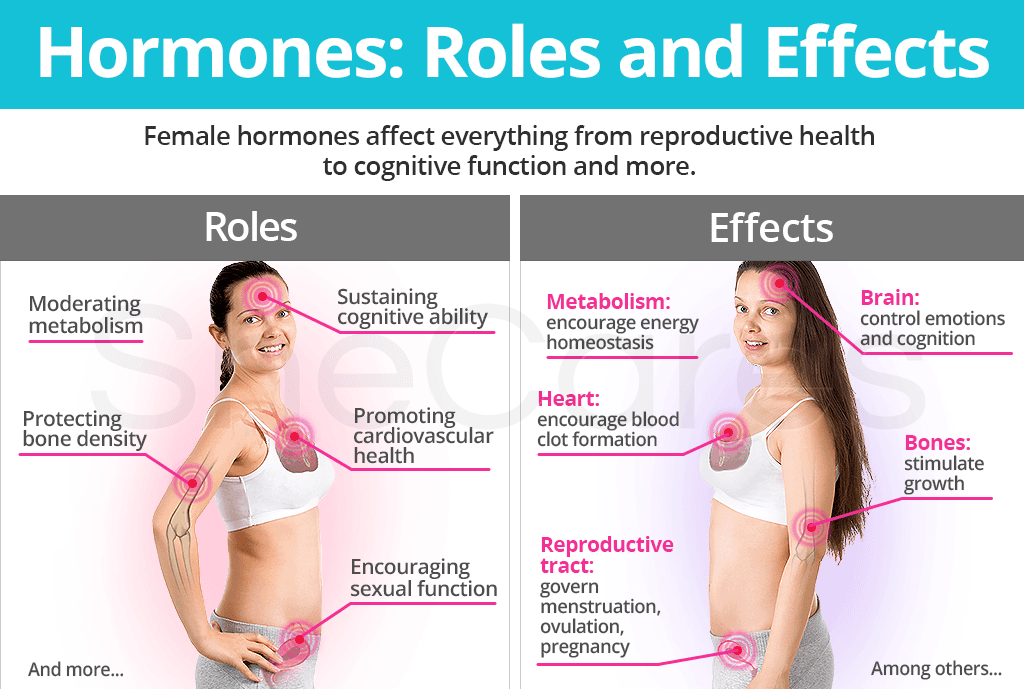
When dealing with hormones, women's greatest tool is information. By having a greater knowledge of how hormones affect physical and psychological functioning, women will be better equipped to take their hormonal health into their hands.
Continue reading to gain a better understanding of the different roles and effects of hormones so that you can stay in tune with your bodily cues.
Roles of Hormones in the Body
Some of the most important endocrine glands in women are the hypothalamus; pineal body; adrenal, pituitary, thyroid, and parathyroid glands; thymus; pancreas; and the ovaries.
Keeping this in mind, the main role of hormones produced by said glands is to serve as an internal communication system them and target organs.
By doing so, hormones are able to positively impact every aspect of the body's functioning on a daily basis, from energy levels and metabolism to growth, development, and response to stressors.
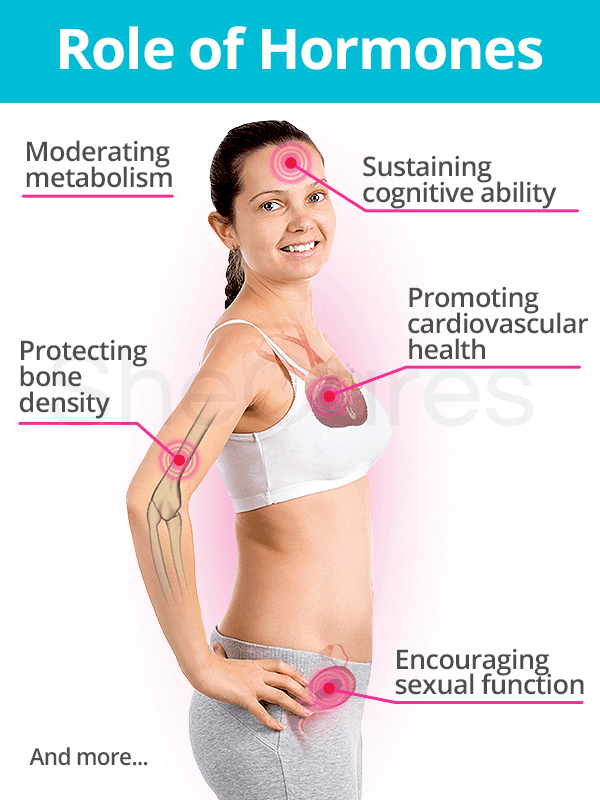
The biochemical functions of hormones in women include, but are not limited to:
- Supporting the health of the female reproductive system
- Guiding the menstrual cycle on a monthly basis
- Bringing a pregnancy to term
- Encouraging sexual health
- Regulating respiratory function
- Protecting bone density
- Sustaining cognitive ability
- Controlling mood and behavioral patterns
- Moderating metabolism
- Promoting cardiovascular health
- Handling overall growth and development
To discover more about the ever-present effects of hormones, continue reading.
Effects of Hormones in the Body
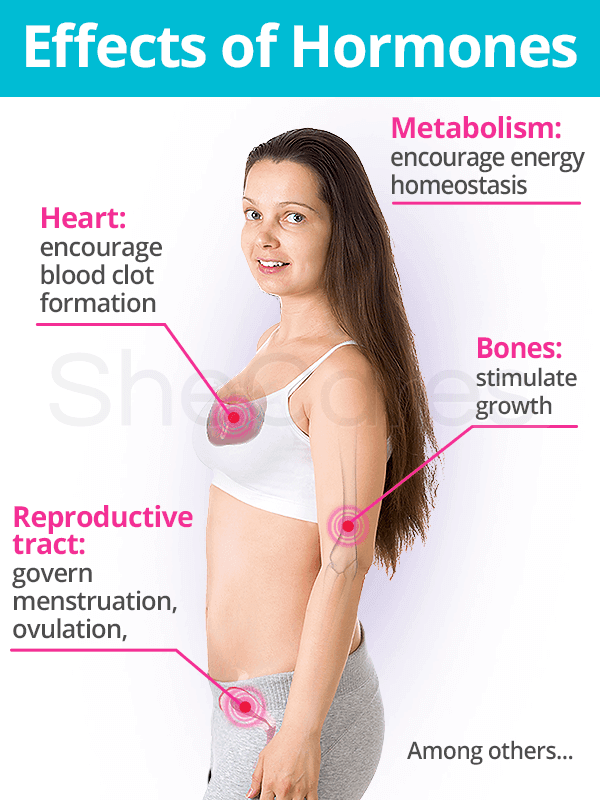
The effects of healthy hormonal levels in women are seen throughout the body.
It is important to remember that the following is just a taste of what the hormones achieve in the entire body on a daily basis.
Reproductive tract
Hormones run the intricate operations of the female reproductive system, governing everything from menstruation and ovulation to gestation and more. While the main players are estrogen, progesterone, luteinizing hormones (LH), and follicle-stimulating hormone (FSH), others such as testosterone are also instrumental in the tract's overall health.
Vagina
Estrogen in a female's body aids the mucus membranes in producing lubrication that works to keep the vagina healthy. It also encourages the growth of healthy bacteria and has a minor acidity level that protects the vagina from foreign bacteria, thus keeping it free from infection.
Respiratory system
Research has found that a number of sex hormones are involved in the regulation and adjustment of breathing by possessing either depressing or stimulating effects. Some hormones have been shown to have local effects on the lungs and airways.1,2
Bones
Numerous hormones - including sex, growth, and parathyroid hormones - positively affect the skeletal system by enhancing mineralization, improving bone density, stimulating bone growth, encouraging absorption of calcium and phosphate from the gastrointestinal tract, inhibiting osteoclast activity, promoting osteoblastic activity, and more.3
Brain
Hormones are intricately linked with our emotions. Ovarian hormone receptors, especially those of estrogen and progesterone, have been found in many brain regions, including the hypothalamus, hippocampus, and amygdala. They have modulatory effects on synaptic communication, principally influencing the systems involved in healthy emotional and cognitive control.4
Metabolism
While many of the biological effects of growth hormone (GH) are still to be discovered, what is known about this anabolic hormone is that it helps moderate metabolism and energy homeostasis. Leptin, adiponectin, ghrelin, and resistin are also all intricately involved with healthy energy homeostasis, glucose and lipid metabolism, and more.5
Cardiovascular system
As a whole, hormones play a leading role in heart health, directly impacting the heart, blood vessels, and cardiovascular system as a whole. For instance, in women, estrogen has been found to promote healthy cholesterol levels, encourage blood clot formation, destroy artery-damaging free radicals, and more.
Nevertheless, women whose hormone levels are abnormal, either due to over-secretion or under-secretion of a particular hormone, may experience health problems. Discover more below.
Possible Effects of High Hormone Levels
When hormonal levels are above what they would normally be, adverse reactions are provoked throughout the body.
Reproductive tract
Although timely elevation of various hormones is necessary to keep the reproductive tract functioning properly, such as when a spike in estrogen triggers the release of the egg, abnormalities in their cycling are recipe for menstrual disorders, including polycystic ovary syndrome (PCOS), endometriosis, and more.
Vagina
When there are elevated estrogen levels in the vagina, as can be experienced with estrogen HRT, women may experience side effects of clear or milky discharge. If this occurs, women should work with their doctor to adjust their treatment regimen.
Respiratory system
During pregnancy, it is believed that increased estrogen levels - specifically - provoke edema in the upper airway mucosa, causing upper airway symptoms such as hoarseness, a constant urge to clear the throat, a sensation of tickling, and more. Moreover, other elevated hormones can cause obstructive sleep apnea, pleural effusion, skeletal muscle myopathy, or decreased carbon monoxide diffusing capacity.6,7
Bones
Conversely, it has been reported that excess levels of parathyroid hormones (from an enlarged gland) or thyroid hormones (from hyperthyroidism or medication) can cause fragile bones and eventually lead to osteoporosis. The same is true - yet less common - with high cortisol levels, a stress hormone created by the adrenal glands.8
Brain
Over-secretion of stress hormones, like glucocorticoids, have been scientifically found to impair memory ability due to altering the brain circuit responsible for memory consolidation and storage. High levels of cortisol, a class of glucocorticoid hormone, brought on by chronic stress also decreases the number of neurons in the hippocampus, thus lessening brain activity.9
Metabolism
Overproduction of the thyroid hormone thyroxine, as is the case with hyperthyroidism, can accelerate metabolism and cause unintended weight loss even when a woman's appetite and food intake do not change.
Cardiovascular system
Research suggests that women who have a higher concentration of male sex hormones - like testosterone - in comparison to female sex hormones - such as estrogen - may be at an increased risk of cardiovascular disease.10
Possible Effects of Low Hormone Levels
Likewise, women whose hormone levels are on the lower end of the spectrum may also suffer from unwanted symptoms and conditions, including:
Reproductive tract
On the other hand, low hormone levels in the body can also lead to menstrual irregularities, including anovulation and irregular periods, as well as pregnancy complications, such as infertility, miscarriage, and more.
Vagina
Poor vaginal lubrication and decreased genital sensation are associated with decreased estrogen levels, especially during menopause. Furthermore, research suggests that low levels of the sex hormone testosterone also contribute to a decline in sexual arousal, genital sensation, and the ability to experience orgasms.11
Respiratory system
Decreased hormone levels, specifically those of estrogen and progesterone during menopause, have been linked to the development of respiratory disorders, such as obstructive sleep apnea, as well as increased upper airway resistance.2
Bones
When there is a sharp decrease in reproductive hormones with menopause, namely estrogen, bone production is affected significantly. This is why the risk of developing osteoporosis - a degenerative bone disease - increases as women reach the end of their fertile years.12
Brain
Conversely, just as low levels of stress hormones can negatively alter intellectual abilities, the opposite has also been found true. Moreover, low testosterone levels can reduce cognitive function as well, and research is developing showing a close link between decreased estrogen and mood disorders, such as unipolar depression.4,9
Metabolism
It has been found that the decreased secretion of GH, a hormone important in metabolism, is characteristic in obese individuals. Its low levels also contribute to the accumulation of abdominal fat and may contribute to other associated metabolic abnormalities.5
Cardiovascular system
Low levels of certain hormones, such as cortisol, thyroid hormones, or GH, can cause hypoglycemia, a condition in which blood sugar levels are too low. Some cardiovascular symptoms of hypoglycemia include an increased heart rate and systolic blood pressure as well as decreased central blood pressure.
Having discussed the various roles and effects that hormones have on the body, continue reading to find out about detecting hormonal imbalance using hormone tests.
Sources
- ACOG. (2015). Vulvovaginal Health. Retrieved November 4, 2019, from https://www.acog.org/Patients/FAQs/Vulvovaginal-Health
- Cleveland Clinic. (2019). Female Reproductive System | Estrogen & Hormones. Retrieved November 4, 2019, from https://my.clevelandclinic.org/health/articles/9118-female-reproductive-system | https://my.clevelandclinic.org/health/articles/16979-estrogen--hormones
- Farkas, H. (2010). Management of upper airway edema caused by hereditary angioedema. Allergy, Asthma & Clinical Immunology, 6(19). doi: 10.1186/1710-1492-6-19
- Frier, B.M. et al. (2011). Hypoglycemia and Cardiovascular Risks. Diabetes Care, 34(Supplement 2), S132-S137. doi: 10.2337/dc11-s220
- Harvard Health Publishing. (2019). By the way, doctor: Is vaginal estrogen safe? Retrieved November 4, 2019, from https://www.health.harvard.edu/womens-health/by_the_way_doctor_is_vaginal_estrogen_safe
- Hormone Health Network. (n.d.). The Endocrine System | Hormones and Your Bones | Non Diabetic Hypoglycemia. Retrieved October 21, 2019, from https://www.hormone.org/what-is-endocrinology/the-endocrine-system | https://www.hormone.org/support-and-resources/resource-library/hormones-and-your-bones | https://www.hormone.org/diseases-and-conditions/diabetes/non-diabetic-hypoglycemia
- John Hopkins Medicine. (n.d.). Anatomy of the Endocrine System. Retrieved October 21, 2019, from https://www.hopkinsmedicine.org/health/wellness-and-prevention/anatomy-of-the-endocrine-system
- Mayo Clinic. (2018). Hyperthyroidism (overactive thyroid): Symptoms & causes. Retrieved November 4, 2019, from https://www.mayoclinic.org/diseases-conditions/hyperthyroidism/symptoms-causes/syc-20373659
- MedlinePlus. (2019). Low blood sugar. Retrieved November 12, 2019, from https://medlineplus.gov/ency/article/000386.htm
- Meier, U. & Gressner, A.M. (2004). Endocrine regulation of energy metabolism: review of pathobiochemical and clinical chemical aspects of leptin, ghrelin, adiponectin, and resistin. Clinical Chemistry, 50(9), 1511-25. doi: 10.1373/clinchem.2004.032482
Footnotes:
- Saaresranta, T. & Polo, O. (2002). Hormones and breathing. Chest, 122(6), 2165-2182. doi: 10.1378/chest.122.6.2165
- Behan, M. & Wenninger, J.M. (2008). Sex Steroidal Hormones and Respiratory Control. Respiratory Physiology & Neurobiology, 164(1-2), 213-221. doi: 10.1016/j.resp.2008.06.006
- Betts, J.G. et al. (2019). Human Anatomy and Physiology. Available from BCcampus Open Education.
- Barth, C. et al. Sex hormones affect neurotransmitters and shape the adult female brain during hormonal transition periods. Frontiers in Neuroscience, 9, 37. doi: 10.3389/fnins.2015.00037
- Vijayakumar, A. et al. (2011). The Intricate Role of Growth Hormone in Metabolism. Frontiers in Endocrinology, 2, 32. doi: 10.3389/fendo.2011.00032
- Saaresranta, T. & Polo, O. (2003). Sleep-disordered breathing and hormones. European Respiratory Journal, 22, 161-172. doi: 10.1183/09031936.03.00062403
- Ali, E.R. (2016). Assessment of functional lung impairment in patients with thyroid disorders. The Egyptian Journal of Bronchology, 10(3), 337-347. doi: 10.4103/1687-8426.193641
- HSS. (2015). Hormone Problems That Cause Fragile Bones. Retrieved October 21, 2019, from https://www.hss.edu/playbook/hormone-problems-that-cause-fragile-bones/
- Ali, S.A. et al. (2018). Hormonal Influences on Cognitive Function. The Malaysian Journal of Medical Sciences, 25(4), 31-41. doi: 10.21315/mjms2018.25.4.3
- John Hopkins Medicine. (2018). Sex Hormone Levels Alter Heart Disease Risk in Older Women. Retrieved November 4, 2019, from https://www.hopkinsmedicine.org/news/newsroom/news-releases/sex-hormone-levels-alter-heart-disease-risk-in-older-women
- Cleveland Clinic. (2018). Sexual Dysfunction in Females. Retrieved November 4, 2019, from https://my.clevelandclinic.org/health/diseases/9123-sexual-dysfunction-in-females
- National Osteoporosis Foundation. (n.d.). What Women Need to Know. Retrieved October 21, 2019, from https://www.nof.org/preventing-fractures/general-facts/what-women-need-to-know/