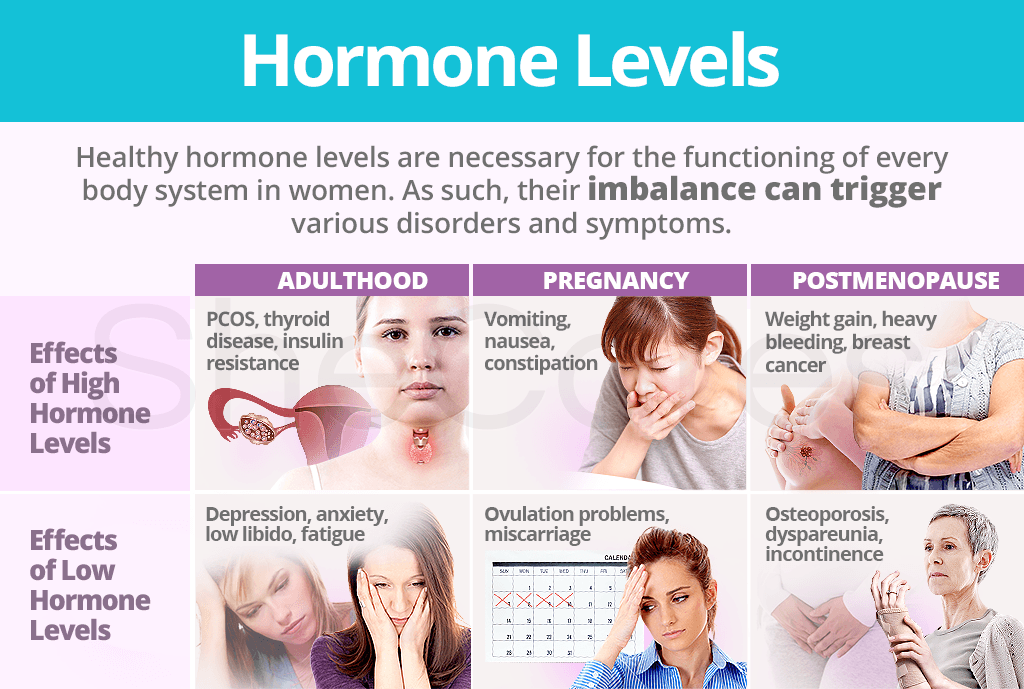
Every hormone plays its own role in a multifaceted chemical messenger system, regulating growth, metabolism, reproduction, and more in women's lives. As such, having normal hormone levels is of the essence for optimal health and well-being far into one's twilight years. Discover more below.
Importance of Normal Hormone Levels
Reproductive, thyroid, adrenal gland, and pituitary hormones are among the many types of hormones present in women's body, making sure it is operating as it should.
Among their various functions throughout life stages are:
During adulthood
- Protect cervix from ascending infection
- Mature reproductive tract and breast development
- Initiate onset of menstrual cycle (puberty)
- Support healthy immunity by modulating inflammation
- Improve sex drive and mood
During pregnancy
- Promote fertility
- Encourage healthy ovulatory patterns
- Maintain pregnancy
- Evoke changes in mother's body for fetal development
- Prompt uterine contractions to initiate childbirth
During postmenopause
- Regulate healthy bone mass and growth
- Boost cognitive function
- Support pelvic muscle strength
- Uphold optimal skin elasticity and thickness
- Lower blood pressure
- Help prevent onset of endometrial, ovarian, and breast cancer
It is important to keep in mind that many of the aforementioned effects occur simultaneously throughout the various reproductive stages.
Discover more about hormones roles and effects for a better understanding of how healthy hormone levels contribute to every body system in women.
What Happens When Hormone Levels are High?
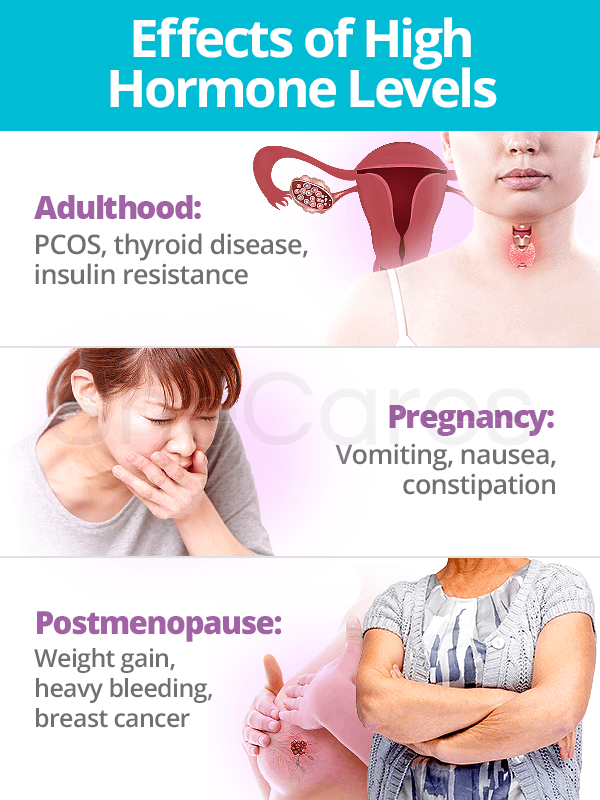
When hormone levels are higher than they should be for a woman's age and reproductive status, various disorders and hormonal imbalance symptoms can appear.
During adulthood
Some of the most common hormonal disorders that can arise in women from high hormone levels include polycystic ovary syndrome (PCOS), endometriosis, and uterine fibroids, causing symptoms of acne, excessive hair (hirsutism), irregular periods, anovulation, infertility, and abdominal pain, among others.
High hormone levels can also evoke thyroid disease, insulin resistance, impaired memory abilities, Cushing's syndrome, hyperprolactinemia, congenital adrenal hyperplasia, and many more.
During pregnancy
It is natural for estrogen and progesterone levels to surge enormously throughout a woman's gestation, and these hormonal surges provoke many early pregnancy signs and symptoms, such as morning sickness, mood swings, constipation, and lower back pain.
During postmenopause
Unusually high hormone levels during postmenopause can manifest into symptoms such as hot flashes, weight gain, breast tenderness, and more. Many types of cancers are also dependent upon hormone levels, and high levels can lead to their development. For instance, it has been found that higher amounts of estrogen in the blood increase the risk of breast cancer in women after menopause.1
In order to find relief from the many discomforts of high hormone levels, click on the following link to learn more about high hormone levels.
What Happens When Hormone Levels are Low?
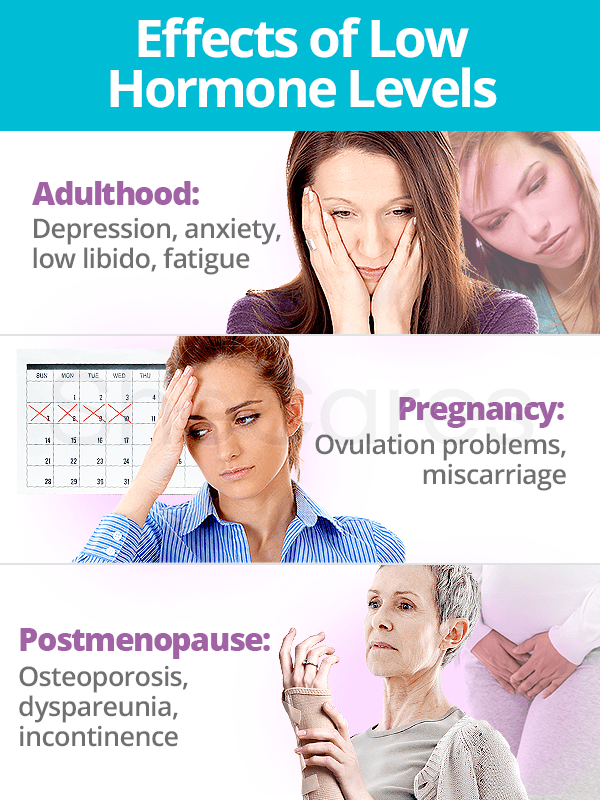
On the other hand, low hormone levels or hormone deficiencies can also wreak havoc in the female body.
During adulthood
Low hormone levels can provoke depression, anxiety, mood swings, fatigue, loss of libido, muscle aches, low blood pressure, cognitive issues, weight fluctuations, as well as thyroid disorders, among others. Keep in mind that many hormonal disorders will mirror those from the high hormone levels section because when levels of one hormone are elevated, another is often low (as is the case with estrogen dominance).
Before / during pregnancy
Before getting pregnant, insufficient estrogen production may lead to ovulation problems, thus hindering conception efforts. Low estrogen also prevents proper build-up of the endometrial lining, needed for the implantation of the fertilized egg. Moreover, without a proper uterine lining during pregnancy, the chances of a having a miscarriage increase, especially during the first trimester.2
During postmenopause
Osteoporosis is a degenerative bone disease that results from an estrogen deficiency; older women are at an increased risk of developing it.3,4 Hormone deficiency in postmenopause can also provoke various other serious health complications, including - but not limited to - heart disease, dyspareunia, and incontinence.
To successfully fight the symptoms of a decrease in hormones levels, click on the following link to keep learning about low hormone levels.
Every woman will experience hormonal imbalance in a different way. The best piece of advice to take is to know your body and report any concerning symptoms to your doctor as soon as possible. Only he or she will be able to make a correct diagnosis through varying hormone tests. Your hormonal health and overall well-being lies in your own hands.
Sources
- Ali, S.A. et al. (2018). Hormonal Influences on Cognitive Function. The Malaysian Journal of Medical Sciences, 25(4), 31-41. doi: 10.21315/mjms2018.25.4.3
- Carpenter, S. (2001). Does estrogen protect memory? American Psychological Association, 32(1), 52. Retrieved November 25, 2019, from http://www.apa.org/monitor/jan01/estrogen.aspx
- Cleveland Clinic. (n.d.). Sexual Hormone Disorders: Descriptions. Retrieved November 25, 2019, from https://my.clevelandclinic.org/health/diseases/17464-sexual-hormone-disorders-descriptions
- Glaser, R. & Dimitrakakis, C. (2013). Testosterone therapy in women: Myths and misconceptions. Maturitas, 74(3), 230-234. doi: 10.1016/j.maturitas.2013.01.003
- Healthdirect. (2019). Dopamine. Retrieved November 25, 2019, from https://www.healthdirect.gov.au/dopamine
- Henderson, V.W. (2009). Cognitive Changes After Menopause: Influence of Estrogen. Clinical Obstetrics and Gynecology, 51(3), 618-626. doi: 10.1097/GRF.0b013e318180ba10
- Imai, Y. et al. (2009). Estrogens maintain bone mass by regulating expression of genes controlling function and life span in mature osteoclasts. Annals of the New York Academy of Sciences, 1173 Suppl 1, E31-9. Retrieved November 25, 2019, from https://www.ncbi.nlm.nih.gov/pubmed/19751412
- Mayo Clinic. (2019). Addison's disease: Symptoms & causes. Retrieved November 25, 2019, from https://www.mayoclinic.org/diseases-conditions/addisons-disease/symptoms-causes/syc-20350293
- MedlinePlus. (2019). Hormone levels. Retrieved November 25, 2019, from https://medlineplus.gov/ency/article/003445.htm
- The National Infertility Association. (n.d.). Common Causes of Miscarriage. Retrieved November 25, 2019, from http://www.resolve.org/about-infertility/medical-conditions/common-causes-of-miscarriage.html
- The North American Menopause Society. (n.d.). Changes in Hormone Levels. Retrieved November 25, 2019, from https://www.menopause.org/for-women/sexual-health-menopause-online/changes-at-midlife/changes-in-hormone-levels
- Seifert-Klauss, V. & Prior, J.C. (2010). Progesterone and Bone: Actions Promoting Bone Health in Women. Journal of Osteoporosis, 2010: 845180. doi: 10.4061/2010/845180
- Society for Endocrinology. (2018). Hormones of pregnancy and labour. Retrieved November 25, 2019, from https://www.yourhormones.info/topical-issues/hormones-of-pregnancy-and-labour/
- Stevenson, S. & Thornton, J. (2007). Effect of estrogens on skin aging and the potential role of SERMs. Clinical Interventions in Aging, 2(3), 283-297. Retrieved November 25, 2019, from https://www.ncbi.nlm.nih.gov/pmc/articles/PMC2685269/
- Weber, M.A. (2015). Local Oestrogen for Pelvic Floor Disorders: A Systematic Review. PLOS ONE, 10(9), e0136265. doi: 10.1371/journal.pone.0136265
- Women in Balance Institute: National University of Natural Medicine. (n.d.). Progesterone and the Nervous System/Brain | Progesterone & Cardiovascular Health. Retrieved November 25, 2019, from https://womeninbalance.org/resources-research/progesterone-and-the-nervous-systembrain/ | https://womeninbalance.org/resources-research/progesterone-cardiovascular-health/
Footnotes:
- Susan G. Komen. (2018). Blood Estrogen Levels. Retrieved November 25, 2019, from https://ww5.komen.org/Breastcancer/Highlevelsofestrogenintheblood.html
- Cleveland Clinic. (2019). Miscarriage. Retrieved November 25, 2019, from https://my.clevelandclinic.org/health/diseases/9688-miscarriage
- National Institutes of Health. (2018). Osteoporosis Overview. Retrieved November 25, 2019, from https://www.bones.nih.gov/health-info/bone/osteoporosis/overview
- National Osteoporosis Foundation. (n.d.). What Women Need to Know. Retrieved November 25, 2019, from https://www.nof.org/preventing-fractures/general-facts/what-women-need-to-know/