Old women with low amounts of testosterone are at increased risk of suffering anemia, investigators report in the July 10 Issue of The Archives of Internal Medicine.
Decreased testosterone levels could be a influential factor for anemia that has been generally neglected according to Dr. Luigi Ferrucci, from the National Institute on Aging in Baltimore, Maryland, and colleagues propose in their study.
In the past, several investigations pointed out that there might be a relationship between testosterone and anemia. That is why Dr. Ferrucci and colleagues research the available information to carry out their study.
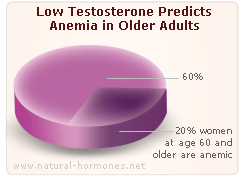 The researchers considered previous knowledge acquired from the World Health Organization, which affirms that anemia is caused by deficiency of iron, vitamin B12, and renal insufficiency. After age 50 years, anemia prevalence rates rises rapidly, to a rate greater than 20% at age 60 and older. Generally, 10.2% of women 65 years and older were anemic. Of older women suffering anemia, evidence of nutrient deficiency was present in one third; and anemia was present in one third. Most cases of anemia were mild; 2.8% of women.
The investigation performed by Dr. Ferrucci is based on an Italian population-based data, in which testosterone and hemoglobin levels were calculated in a representative sample of 905 older adults, 65 years of age or older, who were free of cancer, renal insufficiency or anti-androgenic treatments. Hemoglobin levels were revised 3 years later.
Among those without anemia at baseline, women with low versus normal total testosterone had a notably higher risk of developing anemia at 36 months follow-up, independent of confounding variables. The potential risk of becoming anemic was 2.1 for low total testosterone.
Decreased testosterone levels in women are associated with a higher risk for anemia, and the associationis stronger as testosterone Levels are lower. Separately of age, total testosterone levels were linearly associated with hemoglobin levels.
Despite the statistically significant association between low testosterone level and lowered hemoglobin level, many women with low testosterone levels were not anemic and many of those who were anemic had testosterone levels in the regular range. So, testosterone levels may be associated with anemia, but it is not a crucial caused for this disorder.
These Findings suggest that low levels of testosterone raise the susceptibility to anemia. But, low levels of testosterone may not be a enough causal factor for anemia, probably because the effect can be neutralized by alternative mechanisms.
Low Testosterone Levels and the Risk of Anemia in Older Men and Women. 2006.
Share This |
|---|
Our Readers also liked :
Sorry. No data so far.