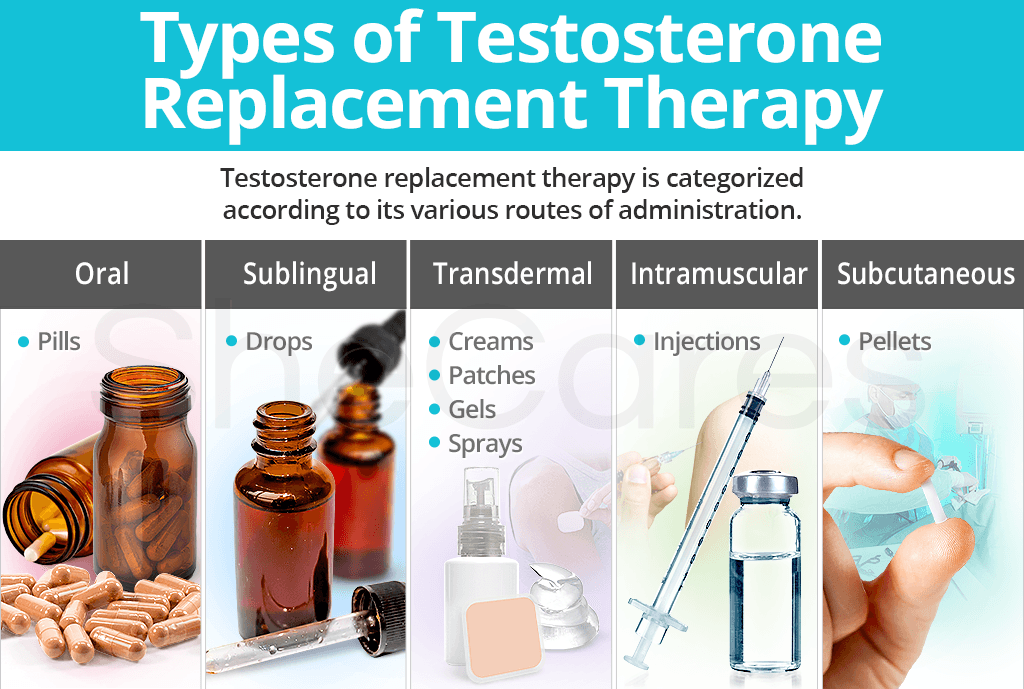
Like with estrogen and progesterone replacement therapy, there are many forms of testosterone replacement therapy, all of which have their own pros and cons and should be used only under the supervision of doctor.
Continue reading below about the most often used types of testosterone replacement therapy so you can go into your treatment feeling empowered with knowledge.
Oral Route

Women who are taking testosterone-only HRT generally do so to treat symptoms associated with androgen deficiency, such as low libido, aggression, irritability, lack of well-being, depression, muscle loss, and more. Close vigilance is necessary as long-term use of oral HRT might lead to liver damage.
Pills
Testosterone pills for HRT are often taken on an alternate-day dosing regimen; however, treatment schedules will vary from case to case.
Sublingual Route
Sublingual testosterone drops are recommended for premenopausal and menopausal women who are suffering from symptoms related to social, cognitive, and sexual decline. This type of testosterone replacement therapy is popular for those who want to increase the concentration of the drug metabolized, but it may be hepatotoxic, which means potentially damaging to the liver.
Drops
Sublingual testosterone drops are a single-dose treatment used to increase free and total testosterone levels in women of all ages. The frequency of their administration will depend upon your specific treatment regimen.
Transdermal Route
Similar to other routes of administration, transdermal testosterone-only HRT is used in the treatment of women with hypoactive sexual desire disorder (HSDD). This route is recommended over the oral route, and it is preferable by those with sensitive stomachs. However, it may lead to skin irritation.
Creams
Testosterone-only HRT cream should be applied to clean skin areas once a day at the same time each day. Massage it in until it is fully absorbed. Keep out of contact with partners, children, and anyone else who is not to be on hormone therapy. Rotate application areas so that no one area becomes too saturated with the hormone. Follow doctor's instructions as this is usually prescribed for off-label use.
Patches
Testosterone replacement therapy can also be administered through a patch. Similar to others, the patch should be applied to a clean, dry area of the skin. It can last for a few days or weeks before needing to be switched, allowing for a steady release of the hormone into the body. Patches are ideal for those who would be forgetful about a daily treatment regimen.
Gels
Testosterone-only gel is also used off-label for women. Depending upon the brand used, testosterone gel is to be used sparingly up to three times per week. Apply it to a clean, dry skin and rotate application sites among the thighs, lower abdominal/pubic area, or wrists. Your dose will be closely monitored and might be adjusted along the way according to its effectiveness or side effects observed by your doctor.
Sprays
Transdermal testosterone sprays are often administered daily for three to four months on the abdomen. Make sure the treatment dries before covering the area, and avoid the area sprayed from coming into contact with anyone else. Report any symptoms of excessive hair growth on the abdomen to your doctor so that dosages can be adjusted or discontinued.
Intramuscular
Intramuscular testosterone injections increase the hormone levels quickly to alleviate symptoms of HSDD. However, testosterone shots are generally considered impractical in women and tend to not be recommended by doctors as they can introduce unhealthily high levels of the androgen into their bodies.
Injections
These intramuscular injections are usually delivered weekly depending upon the set administration schedule. They are inserted into the hip, thigh, buttocks, or arm, and insertion sites are rotated accordingly so as not to over-saturate one area. Doses will be adjusted throughout the course of treatment.
Subcutaneous Route

This type of testosterone replacement therapy is recommended for women with symptoms of low androgen levels, such as low libido, loss of muscle mass, low energy, weight gain, sleep problems, etc. However, with this method of administration, there is no way to adjust dosages. Because they don't have a proper time- release mechanism, hormone levels may initially be too high and then too low later.
Pellets
Subcutaneous testosterone pellets for HRT require a relatively simple procedure to be inserted, and they can last up to three months, which is convenient for those who do not want to deal with a daily treatment regimen.
Precautions
All of these types of testosterone replacement therapy come with a risk of side effects, like female pattern baldness, voice changes, hirsutism, enlargement of the clitoris, acne, and more.
Because these side effects are dose-dependent, they can generally be minimized by working with your doctor to adjust the dosage.
Also, it is advisable for menopausal women who are taking testosterone to do so alongside estrogen replacement therapy.
Keep in mind that for all forms of testosterone replacement therapy, it may take anywhere from three to six months to see desired results.
However, because many doctors do not fully understand the implications of testosterone use in women, they are hesitant to prescribe the hormone and may recommend alternative therapies first to treat symptoms.
These natural options include simple lifestyle changes - healthful diet, stress management, proper sleep, etc. - alongside herbal supplements. Click on the following link to find out more about natural alternatives to HRT.
Sources
- Basson, R. (2010). Testosterone therapy for reduced libido in women. Therapeutic Advances in Endocrinology and Metabolism, 1(4), 155-164. doi: 10.1177/2042018810379588
- Bloemers, J. et al. (2016). Single dose sublingual testosterone and oral sildenafil vs. a dual route/dual release fixed dose combination tablet: a pharmacokinetic comparison. British Journal of Clinical Pharmacology, 81, 1091-1102. doi: 10.1111/bcp.12887
- BMJ Journals. (2009). Testosterone patches for female sexual dysfunction. Drug and Therapeutics Bulletin, 47, 30-34. doi: 10.1136/dtb.2009.02.0007
- Bolour, S. & Braunstein, G. (2005). Testosterone therapy in women: a review. International Journal of Impotence Research, 17, 399-408. doi: 10.1038/sj.ijir.3901334
- Chelsea and Westminster Hospital. (2017). Testosterone replacement for female androgen deficiency syndrome. Retrieved January 22, 2019, from http://www.chelwest.nhs.uk/services/womens-health-services/gynaecology-services/menopause-and-pms-clinics/links/Testosteronereplacementforfemaleandrogendeficiency092017CWAGREED.pdf
- Davis, S. et al. (2008). Safety and efficacy of a testosterone metered-dose transdermal spray for treating decreased sexual satisfaction in premenopausal women: a randomized trial. Annals of Internal Medicine, 148(8), 569-577. Retrieved January 23, 2019, from https://www.ncbi.nlm.nih.gov/pubmed/18413618/
- Harvard Health Publishing. (2013). Testosterone therapy: Is it for women? Retrieved January 21, 2019, from https://www.health.harvard.edu/womens-health/testosterone-therapy-is-it-for-women
- Jean Hailes for Women's Health. (2017). Menopause management. Retrieved January 23, 2019, from https://jeanhailes.org.au/health-a-z/menopause/menopause-management
- Palacios, S. (2008). Advances in hormone replacement therapy: making the menopause manageable. BMC Women's Health, 8, 22. doi: 10.1186/1472-6874-8-22
- Rao, C.G. (2010). The MidLife Health Guide for Women. Indiana: iUniverse. Available from Google Books.
- UTSouthwestern Medical Center. (2018). Attention women: Low sex drive? Testosterone won't help. Retrieved January 23, 2019, from https://utswmed.org/medblog/libido-testosterone-women/
- Van Rooij, K. et al. (2012). Pharmacokinetics of three doses of sublingual testosterone in healthy premenopausal women. Psychoneuroendocrinology, 37(6), 773-781. Doi: 10.1016/j.psyneuen.2011.09.008.