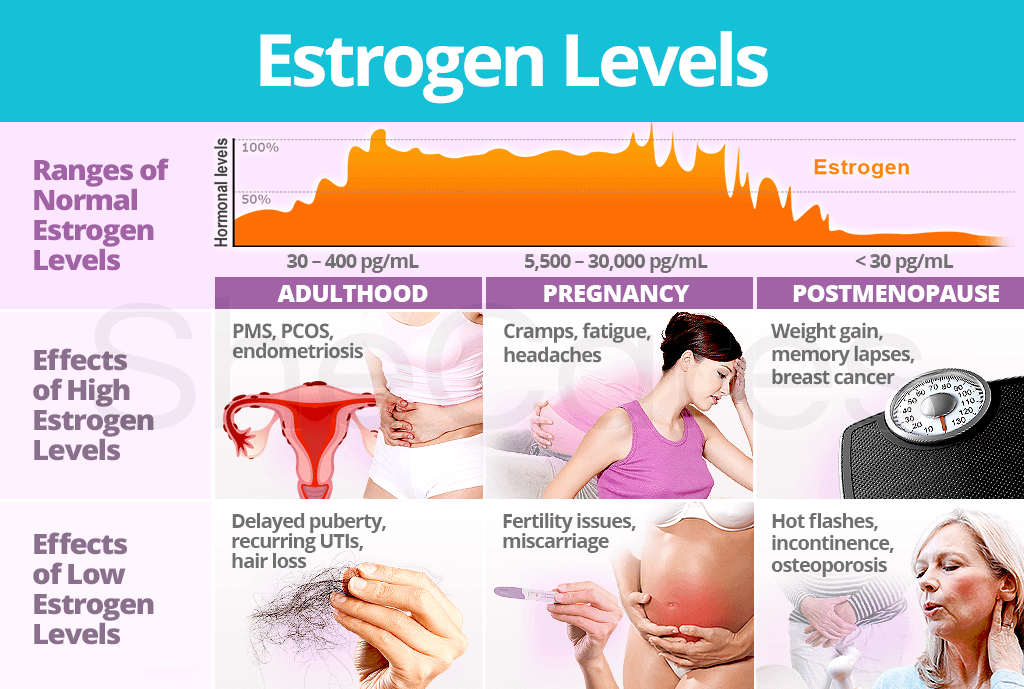
Maintaining normal estrogen levels is vital not only for reproductive health, but a number of essential bodily functions. Unbalanced hormonal levels during any stage in life can wreak havoc on body harmony.
Continue reading to learn more about having healthy estrogen levels and what that means exactly for women.
Ranges of Normal Estrogen Levels
Average Daily Estrogen Levels
- Puberty
- Adulthood
- Pregnancy
- Postmenopause
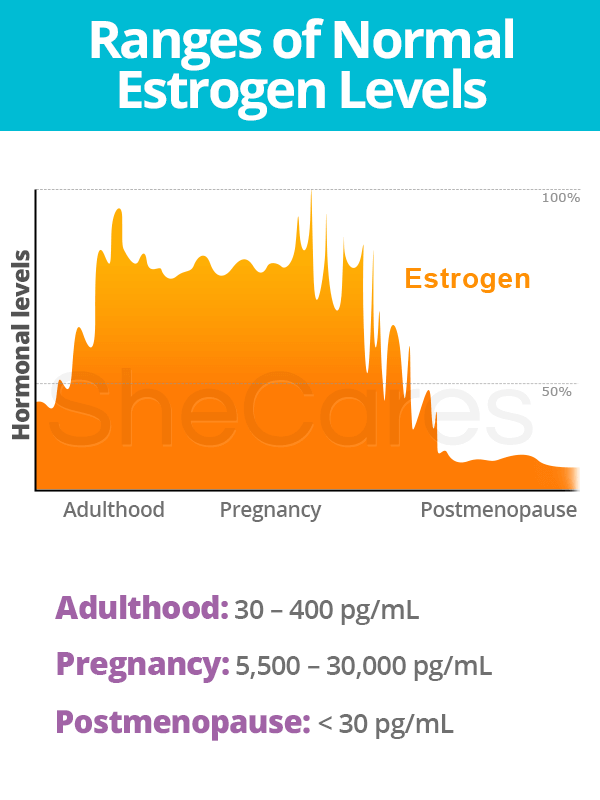
This table shows the average daily estrogen levels for a woman during and after reproductive years. Measurements are taken from blood serum - except for pregnancy's values, which are from plasma - and given in parts pg/mL (picograms/milliliter) of estradiol. Keep in mind that measured levels vary depending on the type of test implemented.
During adulthood
A woman of reproductive age should have estradiol levels ranging between 30 - 400 pg/mL. In the menstrual cycle, estrogen rises during the follicular phase, peaks at ovulation, and then drops during the luteal phase, only to repeat again.
During pregnancy
In pregnant women, blood plasma estradiol levels can range between 5,500 - 30,000 pg/mL. Research indicates that during this time, estradiol levels increase 50- to 180-fold. However, the main estrogen produced by the placenta is actually estriol, which will constitute 60 - 70% of the total amount of estrogens created.
During postmenopause
Estradiol levels will usually hover below 30 pg/mL. After reproductive years have ended, estrone is the main estrogen created. Therefore, its level should be taken into consideration as well. With HRT or other treatments, total estrogen levels can rise substantially.
Importance of Normal Estrogen Levels
The effects of healthy estrogen levels in women are felt beginning with menarche and extending into postmenopause. The following are several examples of the hormone's actions.
During adulthood
- Collaborates with other hormones to initiate the onset of menstruation
- Stimulates the development of breasts
- Matures the reproductive tract
- Prepares breast glands for future milk production
- Maintains thickness and lubrication of vaginal lining and mucous membranes
During pregnancy
- Causes growth and changes in mother's reproductive system and metabolism
- Helps stimulate the secretion of prolactin
- Prompts uterine contractions when baby is at term
During postmenopause
- Regulates bone mass and strength
- Preserves skin tension and strength of pelvic muscles
- Enhances urethral resistance
- Possibly delays memory loss
- Maintains body temperature
Keep in mind that even though many of the aforementioned actions are sectioned into the varying life stages, many of them are present throughout a woman's life.
Read more about estrogen's role and effects for a better appreciation of how the hormone affects the whole body.
What Happens When Estrogen Levels are High?
Because levels of estrogen fluctuate on a daily basis, current estrogen levels are widely based on age, current stage of the menstrual cycle, and external factors, such as stress.
Nevertheless, no matter the variation, an estrogen imbalance in which levels are abnormally high or low can cause a variety of negative effects.
During adulthood
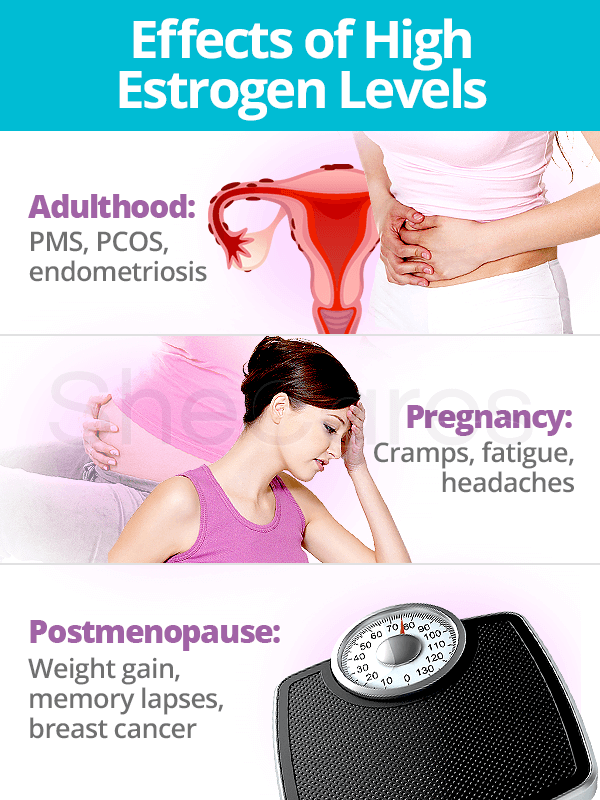
Estrogen dominance can provoke monthly premenstrual syndrome (PMS) symptoms, including breast tenderness, acne, joint pain, migraines, mood swings, bloating, and more.
Also, the longer the imbalance prevails, the more serious health conditions can evolve, turning into polycystic ovarian syndrome (PCOS), endometriosis, and uterine fibroids among others.
During pregnancy
Estrogen naturally increases during pregnancy in order to initiate changes within the mother's uterus, cervix, vagina, and breasts as well as within other areas. However, the sudden influx in estrogen levels may lead to short-term symptoms, like cramps, fatigue, and headaches.
During postmenopause
After menopause, excessive estrogen levels manifest through symptoms such as hot flashes, weight gain, memory lapses, and irregular menstrual periods, among others. If left untreated, the underlying hormonal imbalance can eventually lead to life-threatening conditions such as cancer of the breasts, uterus, and ovaries.
Read more information about high estrogen levels, including warning signs and symptoms.
What Happens When Estrogen Levels are Low?
During adulthood
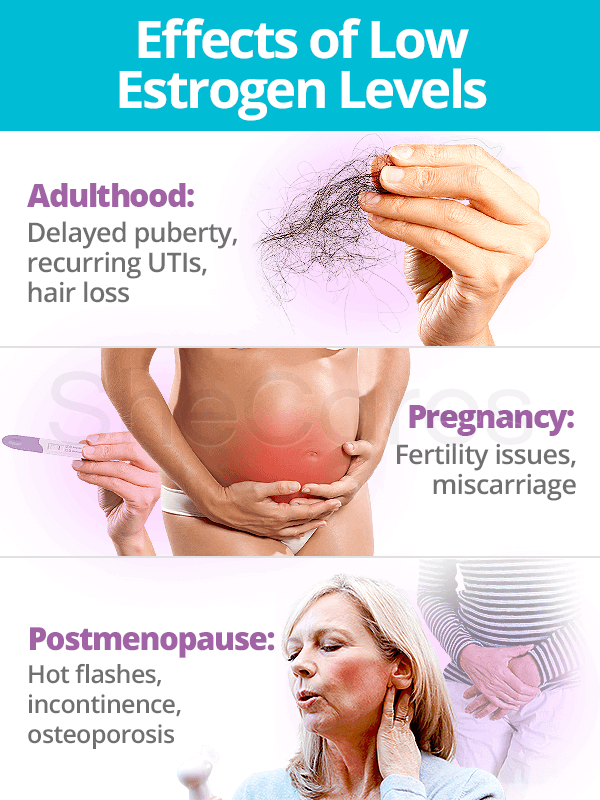
First off, an estrogen imbalance when menstrual years begin can cause delayed puberty. Signs of delayed puberty include lack of breast development by the age of 13 as well as amenorrhea - lack of periods - following breast development.
Furthermore, continually low estrogen levels may lead to recurring urinary tract infections (UTIs), vaginal irritation, hair loss, and further symptoms.
During pregnancy
Having insufficient estrogen levels during the follicular phase may lead to anovulatory menstrual cycles in which there is no ovulation. As such, it is impossible to naturally conceive.
Additionally, because estrogen helps build up the uterine lining in preparation for implantation, an estrogen imbalance can cause a miscarriage if the egg doesn't attach properly.
During postmenopause
When fertile years end, estrogen levels dip below normal, and the hormonal imbalance can lead to symptoms such as hot flashes, vaginal dryness, incontinence, weaker skin elasticity, and more.
If left untreated, low estrogen levels can lead to more serious health conditions, such as osteoporosis, heart disease, and vaginal atrophy, among others.
Accordingly, to begin to clear up any ambiguities in regard to hormonal balance and overall well-being, continue reading to learn more about low estrogen levels and causes.
Sources
- Bader, M. (Ed.). (2008). Cardiovascular Hormone Systems: From Molecular Mechanisms to Novel Therapeutics. New Jersey: Wiley-Blackwell. Available from Google Books.
- Blakeway, J. (2016). Addressing Estrogen Dominance in Perimenopausal Women Using TCM. Retrieved August 14, 2017, from http://www.pacificcollege.edu/news/blog/2016/01/14/addressing-estrogen-dominance-perimenopausal-women-using-tcm
- Breastcancer.org. (2016). Tests to Determine Menopausal Status. Retrieved August 9, 2017, from http://www.breastcancer.org/tips/menopausal/types/determine-status
- Carpenter, S. (2001). Does estrogen protect memory? American Psychological Association, 32(1), 52. Retrieved August 11, 2017, from http://www.apa.org/monitor/jan01/estrogen.aspx
- Eagle, S. et al. (2009). The Professional Medical Assistant: An Integrative, Teamwork-Based Approach. Pennsylvania: F.A. Davis Company. Available from Google Books.
- Henderson, V.W. (2009). Cognitive Changes After Menopause: Influence of Estrogen. Clinical Obstetrics and Gynecology, 51(3), 618-626. doi: 10.1097/GRF.0b013e318180ba10
- Imai, Y. et al. (2009). Estrogens maintain bone mass by regulating expression of genes controlling function and life span in mature osteoclasts. Annals of the New York Academy of Sciences, 1173 Suppl 1, E31-9. Retrieved August 11, 2017, from https://www.ncbi.nlm.nih.gov/pubmed/19751412
- Luthje, P et al. (2013). Estrogen Supports Urothelial Defense Mechanisms. Science Translational Medicine, 5(190), 190ra80. doi: 10.1126/scitranslmed.3005574
- The National Infertility Association. (n.d.). Common Causes of Miscarriage. Retrieved August 11, 2017, from http://www.resolve.org/about-infertility/medical-conditions/common-causes-of-miscarriage.html
- National Women's Health Resource Center, Inc. (2017). Estrogen | Atherosclerosis. Retrieved August 11, 2017, from http://www.healthywomen.org/condition/estrogen | http://www.healthywomen.org/condition/atherosclerosis
- Norris, D.O. (2007). Vertebrate Endocrinology: Fourth Edition. Massachusetts: Elsevier. Available from Google Books.
- The North American Menopause Society. (2010). Changes in Hormone Levels. Retrieved August 9, 2017, from https://www.menopause.org/for-women/sexual-health-menopause-online/changes-at-midlife/changes-in-hormone-levels
- PubChem: Open Chemistry Database. (n.d.). Estriol. Retrieved August 14, 2017, from https://pubchem.ncbi.nlm.nih.gov/compound/estriol#section=Top
- Samuels, M. & Samuels, N. (1996). The New Well Pregnancy Book. New York: Fireside. Available from Google Books.
- Stevenson, S. & Thornton, J. (2007). Effect of estrogens on skin aging and the potential role of SERMs. Clinical Interventions in Aging, 2(3), 283-297. Retrieved August 11, 2017, from https://www.ncbi.nlm.nih.gov/pmc/articles/PMC2685269/
- Tulane University. (n.d.). The Hormones: Estrogens. Retrieved August 9, 2017, from http://e.hormone.tulane.edu/learning/estrogens.html
- University of Rochester Medical Center. (2017). Estrogen's Effects on the Female Body | Health Encyclopedia: Estradiol (Blood). Retrieved August 14, 2017, from https://www.urmc.rochester.edu/encyclopedia/content.aspx?ContentTypeID=85&ContentID=P00559 | https://www.urmc.rochester.edu/encyclopedia/content.aspx?contenttypeid=167&contentid=estradiol
- U.S. Department of Health and Human Services. (n.d.). Premenstrual syndrome. Retrieved August 14, 2017, from https://www.womenshealth.gov/a-z-topics/premenstrual-syndrome
- Weber, M.A. (2015). Local Oestrogen for Pelvic Floor Disorders: A Systematic Review. PLOS ONE, 10(9), e0136265. doi: 10.1371/journal.pone.0136265
- Women in Balance Institute. (n.d.). About Hormone Imbalance. Retrieved August 9, 2017, from https://womeninbalance.org/about-hormone-imbalance/